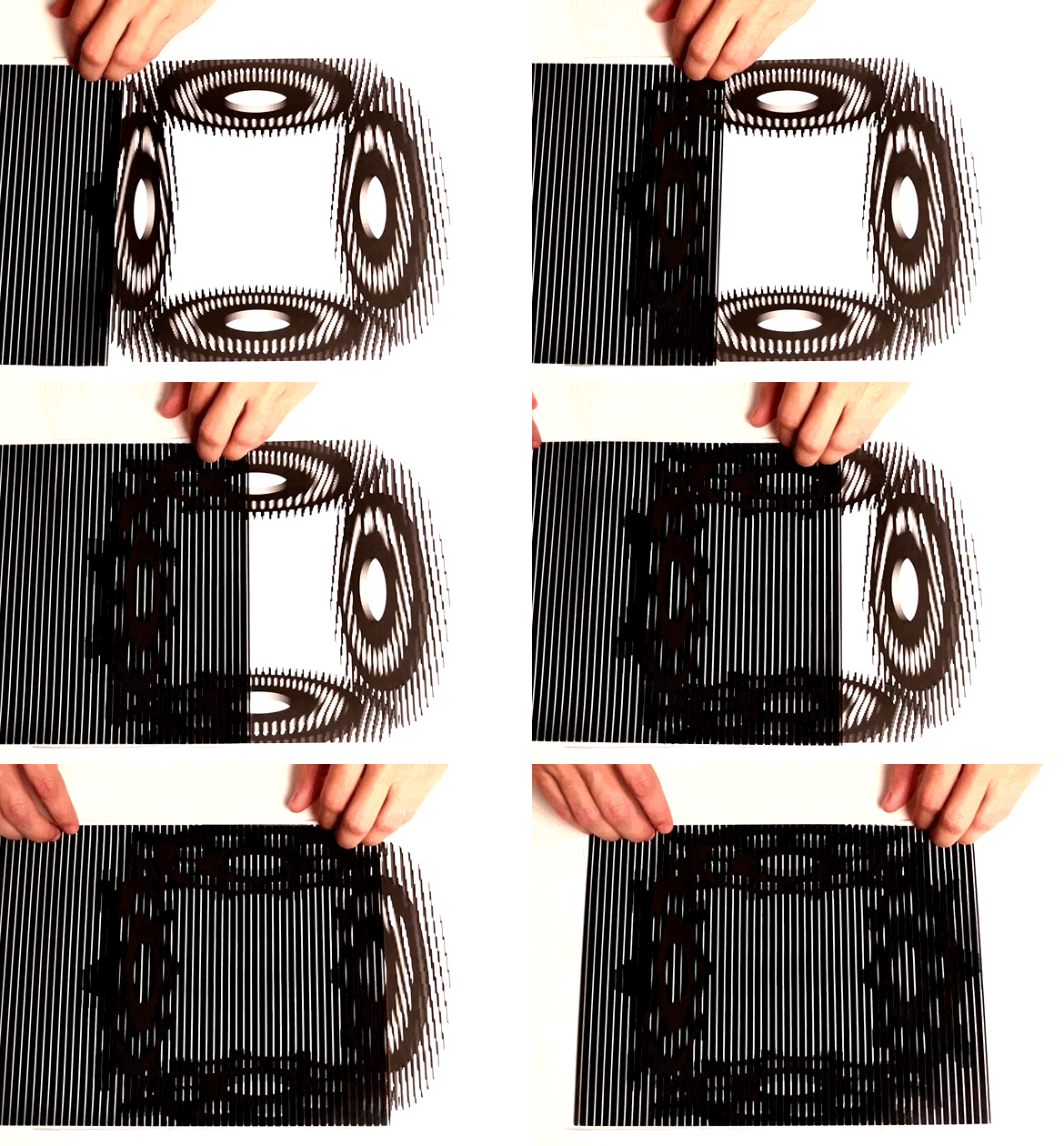
Touching Gears.


giphy-29If you’re familiar with FabLearn, you’ve probably read Seymour Papert’s canonical essay “The Gears of my Childhood” where he describes his formative experiences with gears, cobbling together interlocking systems from an erector set and finding pleasure in their rudimentary functions. Gears became a schema through which Papert could access and understand the world around him and provided a comfort that informed his life-long passion for mathematics and computation. For me, the key excerpt from this essay arrives at the end, where Papert highlights the role of the hands and the heart in learning:

A modern-day Montessori might propose, if convinced by my story, to create a gear set for children. Thus every child might have the experience I had. But to hope for this would be to miss the essence of the story. I fell in love with the gears. This is something that cannot be reduced to purely “cognitive” terms. Something very personal happened, and one cannot assume that it would be repeated for other children in exactly the same form.

As Papert warns, it is important that educators don’t misread his experience to fuel a search for standardized solutions (i.e. one-gear-set-per-child initiatives). Instead, we need to create diverse learning environments to help children find their gears, the tools and objects that might offer intellectual and emotional footholds as they move forward in their lives.

I was introduced to Papert through MIT’s Learning Creative Learning MOOC, which asked us to write about “evocative objects” from our childhood that have informed the way we live and work as adults. Jaymes Dec, a 2014 FabLearn Fellow, wrote one of my favorite reflections to this prompt, recalling the workshop in his family’s basement where he built bicycles, took apart television sets, and explored and thrived in ways he couldn’t in school. My first makerspace was much smaller, a carpet square in my bedroom where I would gather my stuffed animals together and dump out items from my tchotchke bag and use them all to build physical and narrative worlds, priming my interests in theatre, cinema, and storycraft that persist in my head and heart twenty years later. It is an ongoing privilege to have grown up in an environment where I could safely exert my imagination and fall in love through play; not everyone is born into something so lucky.

mcgaw-2016-summer-learning-board-of-directors-report-deck-purple-blue-2

Tactile play is paramount in my after-school program, where we give our middle-school students free reign to opt-in to activities and mess around with materials. Most of our kids like to touch things that we have out on display before they engage in a process or formulate a project. Kids love sculpting with ThermoMorph (pictured above) because it’s squishy and they get to work with hot temperatures in the microwave. They like to dip their hands into vats of Perler beads and use tweezers to sort out the individual beads by color. One student invented a new process of her own by sketching with a glue gun on a silicone mat and then peeling off her doodles (pictured left). About once per week we have someone ask me if they can make “slime” and I tend to re-route them to another activity that’s “way cooler than slime.”
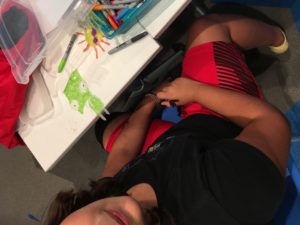
img_3682There’s nothing especially rigorous about these types of engagement — and sometimes it can look like a waste of time and material: when the Thermomorph gets clumped into balls and blobs, the Perler beads spill everywhere and have to get swept up by this hysterically tiny hand-held vacuum, and we run out of glue sticks for design projects that require adhesive. On the one hand, my team and I try to create structures that push students to engage more thoughtfully and in more project-oriented ways. But on the other hand, I think there’s real value to the “petting zoo” approach and exposing students to new tools and a broad set of tactile sensations. It allows students to form an emotional connections which can embolden their future engagement and lead to the beginning stages of meaning-making.

First posts from the 2016 FabLearn Fellows – Inspiration, resources, and confessions

Some of the FabLearn Fellows!

Some of the FabLearn Fellows

The 2016 Stanford University FabLearn Fellows cohort is getting started on a year long journey of sharing their diverse experiences in  schools, community organizations, and museums. They are educators who serve a variety of age groups and populations in North and South America, Africa, and Europe. They are newcomers and veterans, all devoted to the idea that learning in the 21st century must be both hands-on and heads-in.  Throughout the course of the year, they will develop curriculum and resources, as well as contribute to current research projects. Their blogs represent their diverse experience and interests in creating better educational oportunities for all.

I’ve been privileged to mentor this group and part of that is summarizing their amazing blog posts. Here are some blog highlights from November 2016. – Sylvia Martinez

The gorgeous news!

Twenty FabLearn Fellows were selected from over 200 extremely well-qualified applicants from 30 countries. The news came as a surprise and delight!

 shared I’m a FabLearn Fellow and So Can You! with some nifty ideas for spreading the FabLearn Fellowship far and wide. Also sharing the “gorgeous news” was  in Alphonse Is a Stanford Fablearn Fellow! and ‘s experiences as a volunteer to a FabLab manager in Experimenting the power of Hands-on-learning.

 FabLearn conference

The kickoff to the FabLearn Fellow year was the FabLearn conference in October 2016. All 20 new FabLearn Fellows convened from around the world to meet with researchers, students, and educators sharing about making, digital fabrication, and learning. Many of the 2014 FabLearn Fellow cadre members were also in attendance and will continue as Senior Fellows to help guide the journey.

Reflections came from  on What do I do differently in my professional life as a result of FabLearn 2016? and  on Fablearn: the most amazing conference you (probably) never heard of.

One of the highlights of the FabLearn conference was the keynote from Dr. Edith Ackermann which sparked several reflections on design, play, and how the ideas of Piaget and Papert are reflected in today’s maker movement and interest in design as a learning process. In This Is (More Than) a Keychain,  explores this idea in depth as he explains how students deconstruct and reconstruct knowledge AND things when they make with purpose.

 wrote about one of Edith’s comments about Papert’s Perestroika, connecting it to her own students who gain the habits of mind that come from making and tinkering with big ideas, while  wonders in Papert’s Predictions  how (and if) this perestroika he predicted will become the megachange we need in education.  wrote about whether the recent global interest in programming is what Papert predicted or simply more of the same teaching methodology masquerading as preparation for  “STEM jobs” in Megachanges and programming curricula.

Confessional booth

In which we learn much about FabLearn Fellows  who is Diving In,  Confession by  and HELP! MAKER PROJECT CHAOS by . Short version: can’t swim/wanted to be a PE teacher/has too much stuff.

 Nuts and bolts

FabLearn Fellows are practical, too. Sharing great ideas for hands-on learning and tools is part of the fun!

Last but not least…

Coping with the challenges of our political aftermath – in our classrooms…. by  on coping with the unexpected results of the US election and what a teacher’s role is to “work with our students to reshape the world.”

Thanks for being FAB-Learners!

Please subscribe to the FabLearn Fellow blogs,  follow us on Twitter using the hashtag #FabLearn, or follow all the FabLearn Fellows on this Twitter list.

Reinventing the Makerspace Starter Kit

fullsizerender-12

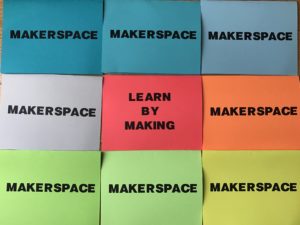
One of the most popular resources on my blog DesignMakeTeach.com is the Makerspace Starter Kit. It is designed to empower educators to claim space in their instructional area for learning by making. I give out the kits at my workshops to motivate and inspire educators to action. I ask educators to plant a Makerspace seed and start accumulating tools and resources around it. Inside the brightly colored cardstock tents, I have a list of free tools, materials and resources to help start a Makerspace.

There have been a wave of new resources and tools available for starting educational makerspaces since I created the kit. I need your help to improve and reinvent the Makerspace Starter Kit.

What are your favorite free Makerspace tools and resources?

Where do you go for help, encouragement and inspiration?

What resources or advice do you give to educators starting their own Makerspaces?

Please leave your ideas in the comments or contact me on Twitter @DesignMakeTeach


Makerspace Starter Kit: Version 1

Side 1: MAKERSPACE

Side 2: Learn By Making

Inside:
-Recycle bin (Duck Tape Optional)
– Crafting supplies
– Toy Bins
– buildwithchrome.com : LEGOs!
– Tinkercad.com : 3D Design
– Inkscape.org : 2D Vector Design
– 123dapp.com/catch : Photos to 3D Models
– scratch.mit.edu : Programming
Resources
-inventtolearn.com/resources
-Thingiverse.com
– 3D.si.edu
– Instructables.com
– Diy.org
– Code.org
– Make publications (via Safari Online)
– makered.org
– makerspace.com
– #makered Twitter chat Tuesdays 9PM (EST)
– DesignMakeTeach.com

Lesson Plan: 3D Printed Lithophane

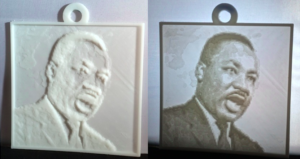
I submitted the following, Lesson Plan: 3D Printed Lithophane, as a last minute entry into the FormLabs: Innovate and Educate Challenge in hopes of winning a Form 2 resin 3D printer. Entries composed of a lesson plan pdf and related STL files were required to be posted to Pinshape. My lesson is posted at https://pinshape.com/items/29307-3d-printed-lesson-plan-3d-printed-lithophane. The Form 2 has been on my Ultimate Home Digital Fabrication Workshop list for more than a year.

mlklithophanephoto

One of the issues I had with my entry is that I have no idea what educators want out of a digital fabrication ‘lesson plan’. Do educators want a word-for-word lesson with screen shots of every technical step and sample files? (more…)

Introducing to the procedural Design

procjam-Fablearn

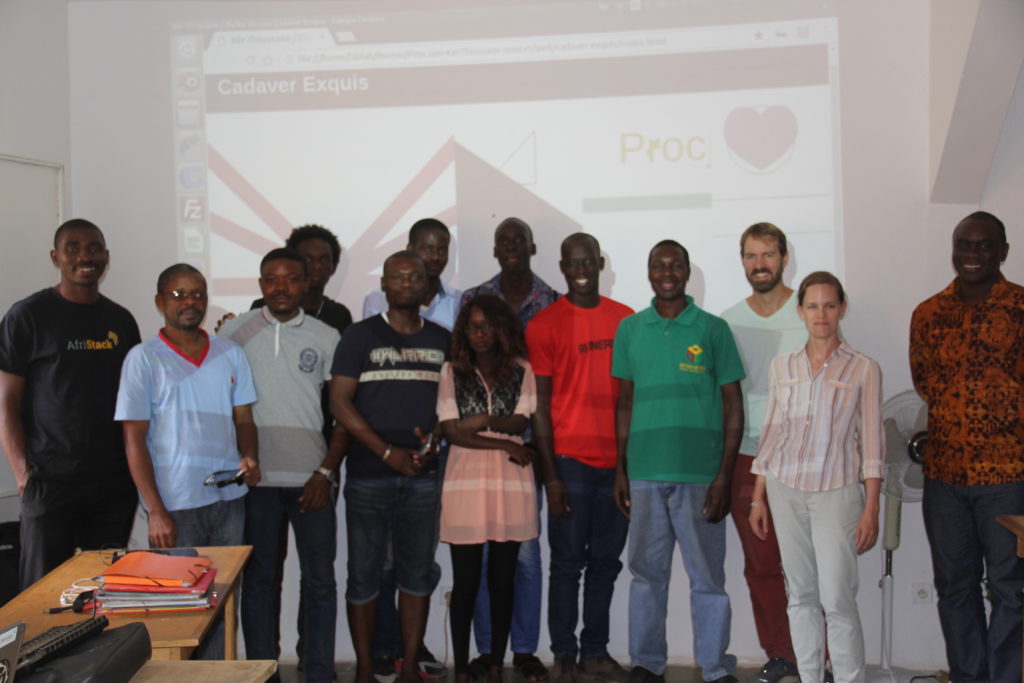
“ProcJam (For Procedural Jam) is defined as “an international “game jam” where people make things that make things. These “things” can be software that generates images, stories, or game levels. They could also be physical projects, such as a board game with dynamic layout, a wind chime (thing that makes music), or a set of rules on how to draw something”.

During two days, members of Defko Ak niep FabLab (Dakar, Senegal), youth from our community as well as the wider ProcJam community worked together and shared ideas with each other.

Day one:

drawing-procjam

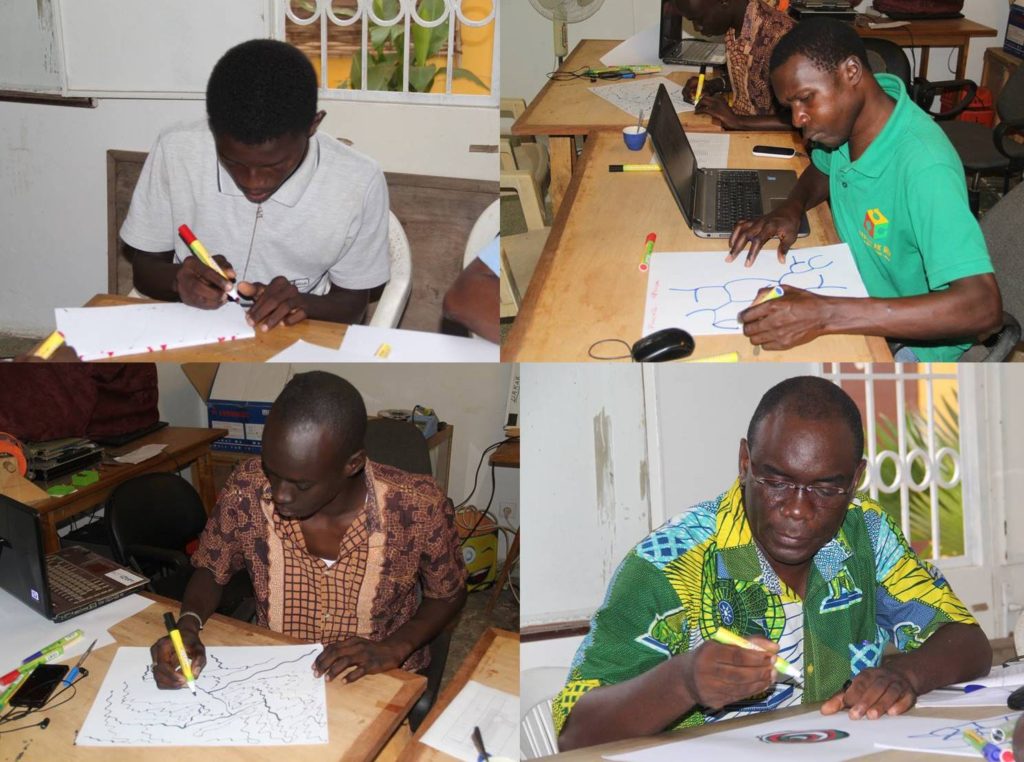
Participants get into the spirit of ProcJam through a series of exercises and examples demonstrating techniques for procedurally generating drawings.

First, they begin drawing by hand on paper, and then started to make similar drawings in a web browser using the JavaScript programming language.

Day two:

javascriptdesign-procjam

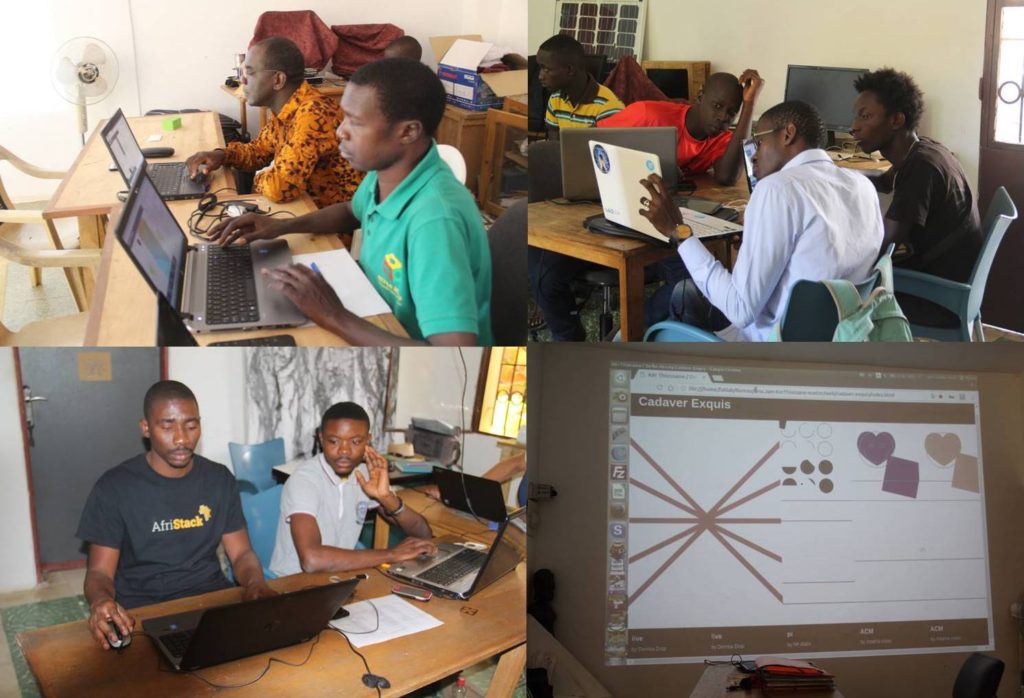
Participants produced their own procedural projects.  Following the introduction on Day 1, they came in with their own ideas and realized their procedural project individually or with a group.

One thing interesting is that people with knowledge of design and JavaScript made themselves available to assist and help out other participants with their project conceptualization and realization.

Watch the Video:

These two days gave participants, with different backgrounds, the opportunity to learn the basics of code writing using JavaScript as well as some other modern design fundamentals.

Please visit the following link to see the ProcJam productions: https://sansumbrella.itch.io/cadavre-exquis

A special thank goes to David Wicks, for his willingness to share with all the participants his knowledge and experience on JavaScript programming language.


Diving In.

giphy-13

I never learned to swim. I can vaguely float. I can blow bubbles and tilt my head to breathe. I can wrap my body in a pool noodle and kick mightily until I’ve splashed myself breathless. But I can’t put it all together and swim a casual lap.

It’s not for lack of trying. My parents enrolled me in beginner swimming lessons for five summers in a row. At eight years old, I became Mingo Community Pool’s pint-sized Wooderson, Matthew McConaughey’s character in Dazed and Confused (without any of his lechery or swagger, of course). Each summer would culminate in a public showcase where the new swimmers would hop off the low-dive and their parents would golf-clap and everyone would feel proud that they could finally survive in The Deep End. When it would become my turn to strut my strokes, I would shuffle to the edge of the diving board, feel the uncomfy sand particles against the roof of my foot, peek into the maw of the pool, calculate the cost-benefit of a cannonball gone wrong, determine that it was not the time for risks, and trot back down the metal steps, bone-dry and despairing. Despite my performance anxiety, I still received the same golf clap that everyone else did and even a certificate of participation to take home and pin to my bulletin board.

For many years, these early experiences haunted me and I boycotted swimming and other water-related happenings. I lived a life without pool parties or water slides, and I accepted a B- in sixth-grade PhysEd for sitting on the side lines during the swimmer safety unit. I’m not proud to admit that even as an adult I’ve turned down invitations to picnic on the beach because of the potential social pressure to group swim after the meal.

Since then, something has shifted in me. For one, I realized that beaches in Chicago, where I live, are one of my city’s greatest gifts and that staring into the ocean at night makes me feel humbled and grateful that I was born on this extraordinary planet, and that swimming pools — in the right heat and on the right roof and with the right assortment of floatation devices — can be a real blast, and that I don’t need to be Ryan Lochte (nor do I want to be Ryan Lochte) to enjoy myself. There are many ways to find value and pleasure in the water and some of them involve chilling by the shallow end.

I am reminded how my toes felt, dangling off that diving board, in this moment, as I stare into the overwhelming white of my debut FabLearn blog post. The 2016 Fellows are a real dream team and I recommend you checking out a few of the thoughtful reflections that have preceded mine – but it would be disingenuous for me not to mention the traces of anxiety I feel when I think about sharing my work, which is often always messy, scrappy, and young:

I have never blogged before.

The makerspace that I manage is only two years old and has a lot to figure out about itself, like what to do with all of these projects and projects-in-process and scraps and recycled material. (Ahh! I feel your pain, Josh.)

I am not an engineer.

My mathematics training began in college with a fabulous class on “Puzzles & Paradoxes” taught by the immortal David C. Kelly. But then it ended when I transferred to Oberlin College and became a Cinema Studies major.

I have arrived in the world of after-school education after a brief stint teaching at a (*vom*) no-excuses charter school.

I don’t know what I’m doing at all —

— until suddenly I do, which I am discovering is how expertise feels as it builds in real-time. One of my favorite aspects of maker education is how it can accommodate messiness and the unexpected and that it’s a movement built on the backs of scrappy teams which are all figuring things out together. Blogging and tweeting can be instruments of vulnerability and generosity that create a vibrant ecosystem filled with (increasingly) diverse voices and dispersed knowledge. Over the next few days, I am going to share with you more about my program, the projects that I’m working on, and the puzzles in my work that need solving, and I look forward to your feedback, pushback, and friendship.

I read an article in The Atlantic once about how to transform anxiety into excitement. The gist is that all you have to do is say “I am excited” instead of “I am nervous” and your brain reappraises your jitters and funnels that energy towards increased performance.  In the spirit of that and in the spirit of collective knowledge-building, let me say that I am excited to take this leap with all of you here now.

[A polite golf clap can be heard from the bleachers.]


Confession

Although I choose not to bring it up often, I have a confession to make. You see, when I started considering teaching as a career years ago, my passion was to be a physical education teacher. So, being the goal-orientated person I am, I got my undergrad and graduate degree in physical education. I got my state teaching endorsement in health and fitness. I attended conferences and workshops galore on physical activity and wellness. For my first employment opportunity, I found myself in an interview with administration and teachers, where it was stated that, “We only have a position for a part-time P.E. teacher, but we also have an opening for a technology teacher. Can you teach a kindergartener how to use a mouse?” Of course, I can teach a kindergartener how to use a mouse. I thought, if it means I can teach P.E., I’m in. My confession: For all intents and purposes, I was supposed to be a P.E. teacher. 

Fast-forward a few years. On Monday, Wednesday, and Friday I’m teaching students the proper footing for overhand throwing, setting up a gym for a game of kickball, and stressing the importance of healthy eating. On Tuesday and Thursday, I’m sitting in a traditional computer lab, looking down the rows of computers, seeing the occasional eyes pop-up over the monitor, as I remind students how to hyperlink slides and keep their fingers on home row. The students are excited to have screen time but are ultimately running through the motions. As hard as I try to keep students engaged and be cutting edge, I’m not doing well. I’m bored with the routine and I think, if I’m bored, my students have to be feeling similarly. I know of a school in the area, that is incorporating engineering and design into their curriculum, a rare find at the time. That spring, I pitch an idea to my administrator, “I’d like to incorporate some engineering and design into technology. Would you support the idea?” He loved it, but neither of us had any idea of what was to come.

I was so excited, I started the next week. I knew third grade was learning about simple machines in science so I went and bought a handful of windup toys. Third-grade students spent the next week taking them apart, documenting photos and labels with the tablet, attempt to identify any simple machines they found, then figuring out how to put it back together. The kids couldn’t believe they were getting to take apart and explore toys in technology class. They were engaged. They were excited. They smiled, laughed, and shouted to their classmates when they made a discovery. They were hooked, and better yet, so was I.

The next school year, I set a goal. I was going to do one hands-on design project with every grade level. I just had to convince the classroom teachers that what I was doing was worthwhile. I needed to gain their trust so that when they sent their students to “technology class” once a week, and they weren’t setting eyes on a screen, that they could still recognize the importance of it all. I started emailing and meeting with every teacher, listing their units of study. I turned to Pinterest and Instructables. I talked out ideas with friends and family and I turned to my own imagination. That school year, while we still did a lot of screen-based technology, there was more happening. I kicked off the school year showing students, Cane’s Arcade, a viral video about a child who created a working arcade out of cardboard and other recycled materials. Then, we made our own school cardboard arcade. The computer lab was so full of cardboard boxes, during the weeks students were designing and making, that I was told I was putting the school at risk of being in violation of fire code. We put on a giant arcade in the gym where over a hundred students proudly shared their creations.

Throughout that school year, I slipped in hands-on design projects. Third-grade screen printed geometric designs on t-shirts using homemade screens and geometry blocks to tie into their math unit. Second grade built a 3D city out of paper to learn about community helpers and city planning. Kindergarten built and tested bridges made from toothpicks and marshmallows and learned about architectural engineering and design. Fifth-grade students learned about biomimicry and invented and constructed their own devices that were inspired by nature. Teachers were appreciating the collaboration. Parents were happy their students were coming home excited to talk about what they did in class. Students were engaged, they were having fun, and they were learning.

The process continues to grow for me and for our school. The following year, I asked to change the name of my class from technology to S.T.E.A.M. I wanted everyone to understand that more than computer and tablet usage was happening. The computer monitors that once sat as the primary feature on table tops were now more often pushed aside to allow for cutting, gluing, drawing, designing, and constructing and I wanted a name to reflect the change.

The year after that, I pitched the idea that I would quit teaching P.E. and move to teaching in the lab full-time, where students would come to class twice weekly instead of once. The idea was approved. That same year, the school moved into a new building, where I was able to help design and plan our lab. We have moveable tables with tons of floor space for students to build. We have laptops and tablets that can be used when needed but set aside to allow for more space when making. We have a sewing machine and a workshop table with hand tools. We have a prototyping materials cupboard filled floor to ceiling with everyday materials and recyclables. There is a cupboard with toys to spark imagination and reinforce ideas such as marble runs, robots, building blocks, and art sets. While it isn’t a multi-million dollar facility with laser cutters, multiple 3D printers, and CNC mills, we are making. Students are practicing the design process daily. There is room for play and discovery. Students are encouraged to prototype, test, and redesign. Their imaginative ideas are met with encouragement. They know the lab is a safe place to take risks and test new ideas.

So, if you find yourself stumbling upon the Maker Movement, know that you don’t have to have an engineering or design background. You don’t have to find a school with a program already in place. You don’t need the latest gadgets and costly equipment. But, you do have to be willing to start. You have to be willing to collaborate with colleagues to gain their trust. You have to show that what you are doing is benefiting the students. You have to be willing to spend the time, doing the research to find project ideas and inspiration that fit into your program. And, just as you will ask of your students, you have to be willing to take risks. Trust me, the rewards are worth it.

Resources:

Cane’s Arcade

Experimenting the power of Hands-on-learning

fablearn-defkoakniep1

When I started working as a FabLab member and then as a FabLab manager, I never thought that it will be such a great experience in term of leadership, professional and personal development.

My journey as an “African Fablaber” started 4 years ago as a volunteer with an NGO in Lomé (Togo). I used to share my time and experiences by providing basic computer trainings to students, kids and everyone in the neighborhood that needed it or just curious about it.

When I discovered digital fabrication machines like 3D printers and everything that can be realized with it (in the African context), I decided to specialize and master it ”perfectly” in order to share and disseminate my knowledge within my community. Indeed, my experiences with Fablabs in West Africa, Europe and US showed that it can promote local economic development, strengthen social cohesion and capacity buildings of local communities.

With Defko Ap Niep in Dakar (Senegal), we initiated many programs to bring hands-on-learning system to local schools. We started pilot-projects and we are impressed by the power of learning-by-doing because in just half an hour, 8 years old students were able to solder electric circuits.

They could also design 3D models and print it out by themselves. Most of them have never used computers before nor have soldered electronic components because IT or electronic classes are not available in their school programs.

That is the power of Hands-on-learning and I am looking forward to share more experiences very soon.

Thinking about 3d Geographical Representations

As a history teacher, I work with maps. I work with students to see how maps can help them understand events. I work with students to read maps. And I work with students to help them make maps.  As we look toward one of the big projects of the 8th grade year, National History Day, I was thinking about how students might present geographic information when they chose to make exhibits, and I created two 3D maps of the island of Kauai. (Not for any deep historical purpose, but because I like it there, and it is a good size and shape for 3D representation.)

kauaiitimes2

Obviously I created them at different scales, but the hope was that I could use each to show students the possibilities. The one on the left was sliced in 123D Make and cut out on the laser cutter, the one on the right was 3D printed (Makerbot 2). Both came from STL files originally created here: http://jthatch.com/Terrain2STL/

One of the things I want to help students do in the maker classroom is try things out and decide what might work best.  This is the first of a series of options I hope I will be able to make myself to show students what is possible. More to come.

Papert’s Predictions

The process of changing the system  through technology is a very actual topic, not only in the education field.

As Papert says in his speech  “Perestroika and Epistemological Politics” this is a kind of revolution so radical  that we can definitely call it  megachange.

It’s not so difficult to imagine how the work and the life of most of us is changed compared to a 1916’s person. It’s impossible to unrecognize the role that technology plays, as vector, in this megachange. The wake of scientific and technological progress in so many fileds leds us today to have computers so little that can be placed on an hand, no limits in comunications and an huge constellation of new cultural and social technology-related constructs that are shared almost wordwide.

On the other hand it’s very difficult to predict how much everything can change in the next 100 years, moreover in the educational field and in  the structure of knowledge itself.

It was 1991 when Papert predict what will be  the role of computer in the educational field:

“The computer is not an agent that will determine the direction of change. It is a medium through which different forces for change can express themselves with special clarify.”

After 25 years we can truly see how much close Papert goes with his prediction….soo many forces plays a role in this technological revolution.

The production system is letting us become more and more passive in the relationship with technology. Most of our beloved “digital natives” doesn’t know what’s inside their smartphones , tablet and videogame consoles…. even worst, they are unable to use creatively all the media than they have available. Lot of schools and teachers choose to use technology as a new tool to teach in the old way or, even worst, are teaching new things in the old way.

Maker movement and maker education has played an anti-hierarchical role in the last years, spreading the value of making on your own, working on projects you care about and sharing with your community. Taking the learning outside of schools to makerspaces and,  as we are seeing more and more right now, taking the makerspaces and fablabs  inside schools too.

So, despite the lack of consciousness and understanding about how technology works children have, right know more than ever, many chance to experiment, play, learn and create with technology. Everywhere in the word there are some revolutionary teachers that are trying to change the old paradigm of education and most of them are using technology as an ally, a tool that can help to offer a better learning environment.

Even if everything can look fine, there can be some dark hierarchical clouds on the way, as companies understands how maker-market can be profitable they will try to control it, it will not be “make your own” anymore but “produce your product with our product”. Even into a school maker space or fablab a teacher can choose to teach in the old way, and use 3D printers, laser cutters and all the other tools to instruct their kids instead of letting them construct their own knowledge.

I’m not sure if this game of forces will end up at some point, I’m truly wondering if the real nature on the “human-beeing system” is to be constantly balancing between different kind of forces.

What I know is that, right now more than ever, we can choose to use technology as an instrument to be creative with.

We can choose to help teacher construct their own sense of meaningfulness about technology.

We can offer our pupils a learning environment rich in contents and meaningfull, where they can express themselves and learn how to construct their own knowledge.

Everyone can play a role in this mega changing process, let’s choose wisely!!!


Resources

Perestroika and Epistemological politics Seymour Papert

Start Making afterword Mitchell Resnick