Constructivist Science

In response to a literal call for #HELP on Twitter, I pulled together three blogs from various resources. This is blog 2 of 3 to construct my own knowledge on the topics of making in schools and the two learning theories constructivism and constructionism. 

Constructivist Science

The idea that each individual should learn through direct experience rather than direct instruction is one so obvious to real scientists that the Latin phrase Nullius in Verba, which translates to ‘take nobody’s word for it’ was adopted in 1660 as the official motto of The Royal Society of London. According to The Royal Society’s website, the motto was adopted as “an expression of the determination of Fellows to withstand the domination of authority and to verify all statements by an appeal to facts determined by experiment.” A scientist is a constructivist by nature and profession.

In the late 1700’s and early 1800’s an educational reformer was working with children right around the same time that “science” was being revolutionized in Victorian England by such icons as Faraday, the Herschel family, and Darwin. Having read Rousseau’s  Émile (1800), a book about education which looked at Christianity critically and was later burned publicly, Johann Heinrich Pestalozzi (1746-1827) affirmed “that teachers and parents never should teach children anything they could learn or experience naturally.” Handed the care of war orphans on January 14, 1799 to educate, Pestalozzi would often say, “learning by head, hand and heart” which related to his use of hands on learning and manufacturing of real world objects by children, as a form of education and a pathway out of poverty. Pestalozzi was a constructivist and a constructionist.


I went gladly, for I hoped to offer these innocent little ones some compensation for the loss they had sustained, and to find in their wretchedness a basis for their gratitude. In my zeal to put my hands to the task which had been the great dream of my life, I should have been ready to begin even in the highest Alps and without fire and water, so to speak, had I only been allowed.

— Johann Heinrich Pestalozzi


Born in 1870, one of the first scientists to focus studies on how children develop cognitively was Italian physician and curriculum designer, Maria Montessori. As early as 1901 Dr. Montessori was advocating for the use of the scientific method to inform curriculum design. Dr. Montessori began her groundbreaking work in the 1910’s on what is now known as the Montessori method, or one of our first modern models of self-directed learning or constructivism.

As a result of the push for standardization during the industrial era, new ways of thinking about learning and consuming were growing up into areas as wide as the Bauhaus school of art and architecture (1919-1933) to the Arts and Crafts movement, to the works of American philosopher and educational reformer John Dewey. Himself influenced by Rousseau and Plato, Dewey would advocate for the role of education in protecting democracy in such works as Democracy and Education (1916). Even though they were describing the idea of constructivism the term would not be coined until Swiss psychologist Jean Piaget (1896-1980) would study young children, beginning with his own. Piaget noticed that children construct an understanding of their world via sensorimotor interactions with their environment. Piaget was highly influenced by Dr. Montessori as well as the Montessori method.

Piaget used the terms assimilation and accommodation to explain the twin processes of constructing new knowledge or understanding. Assimilation happens when the input children take in from their environment becomes part of their schema, or tool box of knowledge. As a facilitator of making in science, I witness learners practice Piaget’s accommodation and assimilation in the act of making, fixing, and deconstructing artifacts. When given the time and materials to explore and test without overt adult instruction, the learner is practicing “constructive autonomy.” Even a self-directed learner may get stuck and need a mentor. Thankfully Lev Vygotsky’s theory of “social constructivism” as well as “zone of proximal development” offers a new mode for assessing and encouraging constructivism. Vygotsky developed his learning theories around the same time an engineer at MIT was also tinkering with his mentor’s theories.

When using a constructivist approach to learning, students are in a constant state of ‘it reminds me of’ while they make sense of the world. This allows new knowledge to “rest” on a fertile foundation of some kind. Piaget called this fertile ground for new learning a person’s schema. If a new idea is incorporated into a learner’s schema, this is called cognitive development, or learning. For anyone to learn complex models and abstract ideas in science, there must first be fertile foundations to latch onto these new models. If fertile ground is absent the new idea may be ignored or rejected outright. Science and technology that can not be assimilated would have the effect of being “magic” to a person not ready to assimilate new ideas. Take for instance how popular science fiction is as a temporary break from our boring old schemas.

Thanks to the innovative work of one of Piaget’s proteges, also the developer of the first computer programming language for children, we would be introduced to a new learning theory which would also apply constructivism in the classroom, and it would be called constructionism. Next, how constructionism gives us the most useful mode for practicing constructivism in school.


  1. Green, John Alfred (1905), The Educational Ideas of Pestalozzi, WB Clive.

  2. Lillard, A. S. (2005). Montessori: The science behind the genius. Oxford University Press, USA.

  3. Pulaski, M. A. S. (1971). Understanding Piaget: an introduction to children’s cognitive development. New York: Harper & Row.

  4. Soëtard, M. (1994). Johann Heinrich Pestalozzi. Prospects: the quarterly review of comparative education, 24(1-2).

  5. Vygotsky, L. (1987). Zone of proximal development. Mind in society: The development of higher psychological processes, 5291.

A Science Teacher’s Take on Constructivism & Constructionism

In response to a literal call for #HELP on Twitter, I pulled together the following three blogs from various resources. This was not as easy of a task as I was hoping, but I continue to model the use of constructionism with materials like words to force me to better understand, aka construct my own knowledge on the topics of making in schools and the two learning theories constructivism and constructionism. I hope that the intended audience finds these blogs useful. If not, references are at the bottom of each blog so the reader can construct her own interpretation of constructivism and constructionism using the historical evidence.

Construct-a-what?

One of the beautifully ironic traits of the pedagogical theories constructivism and constructionism is that a deep understanding of either is impossible from just reading this, or any text. Nevertheless, try this metaphor; if constructivism was a backpacking trip into the Alaskan wilderness on a shoestring budget armed with a “good plan,” then traditional teacher led models are more like an all inclusive, family friendly, low risk Alaskan cruise – look but don’t touch.

Having that “ah ha! I get constructivism” moment is often visceral before you can put it into words. Understanding constructivism authentically, requires you, the learner to experience learning in a self-directed environment to get a good “feel” for the discovery versus consumption path to new knowledge. You must allow yourself or others to play, explore and expand their own umwelt while problem solving or reaching a learning goal.

In the image to the right, we see a great example of how we can use hands on projects such as making models of architecture to learn ideas in math such as measurement and scale from a constructivist and constructionist lens. 

Applying constructivism is a source of great joy and inspiration, but how do we know what we are learning? Growth in the accumulation of knowledge from a constructivist approach (a term used by a learning theorist in the 1960’s) can be hard to measure. You have to rely very heavily on a learner’s communication skills, such as speaking, drawing and writing. The most highly prized form of evidence of learning we have in traditional settings is test scores, despite the fact that tests are designed by teachers for efficiency and can be really badly designed from a learner’s perspective. Constructivism is the discovery approach to learning. Bottom line, provide learners with the tools they need to ask questions and to invent and they can and will drive their own learning. Helpful adult facilitators design the prompts and provocations, but the learner is allowed to discover new ideas independently through her tests and her creations.

Constructionism (a term coined in the 1980’s by the maker of the first programming language for children), is accumulation and application of knowledge, through measuring, making and diagnosing to make something. Learning through constructionism shows evidence of possessing and comprehending new knowledge. When a learner has created an artifact from a template, other objects, or from scratch materials, the growth of new knowledge can be modeled to all observers, perhaps even engaging all the senses using the artifacts and documentation. The existence of the artifact, a line of code, a fat free muffin, a photograph, a rubber band gun, is evidence of learning and knowledge, specific to the challenges faced to make the individual artifact.

Not convinced? Try making something you have never made before, without a recipe or kit. You will learn a lot through trial and error or by seeking out reliable how-to videos to apply new skills to a unique situation. While making your object, you are learning through constructionism. The creation of the artifact will drive your learning using all of your senses and nearly every part of your brain. This is a concept that author David Perkins calls “making learning whole.” More on constructionism in a bit. Next, how does real science model real constructivism?


  1. Perkins, David N. (2009). Making Learning Whole: How Seven Principles of Teaching Can Transform Education. San Francisco, CA: Jossey-Bass.

  2. Pulaski, M. A. S. (1971). Understanding Piaget: an introduction to children’s cognitive development. New York: Harper & Row.

What I’m Reading

A few weeks ago, someone on the K-12 Digital Fabrication Google Group pointed out that there are some similarities between teaching making and teaching reading. There was a conversation about the “whole language” movement from the 1980s as well as Nancy Atwell and Laura Robb’s Reading Workshop model of teaching reading. I knew nothing about this, so it peaked my curiosity and I purchased Robb’s, Teaching Reading in the Middle School.

Usually my classes are a bit chaotic with 16 students all working on their own projects using different tools, techniques, and materials. I don’t do any direct instruction, preferring for students to figure stuff out on their own or with the help of online resources and their peers. It can be difficult to help scaffold student knowledge construction and help them figure out what they need to learn to finish their projects when everyone is working on their own diverse projects and I am moving around the room trying to expose their thinking and get them to talk about what they are doing and making. To be honest, I have an emerging handle on classroom management, but it can be difficult to facilitate such an unstructured class with 6th and 7th grade students who are just beginning to learn how to use the tools of digital design, fabrication, and physical computing. I feel like some students need more support to learn how to figure out what they need to know to make a project.

I’m really enjoying Robb’s book. It’s giving me some ideas for how I can structure my class so that students get the support they need, but still allow for them to do a lot of individual making on their own. I particularly like how she starts by identifying 7 Key Reading Strategies. Then she breaks her classes into several learning experiences (Read-Aloud, Gathering, Mini-Lesson, Guided Practice, Choice Time, etc) that allow her to model those strategies, allow students to practice those strategies, and to encourage students to share those strategies with their classmates. My only hang-up is that my classes meet so infrequently (60-75 mins every eight school days), that it is hard to carve out the time to do all of this and still get projects done. Robb’s classes meet everyday for large blocks of time (90 minutes).

But since starting the book, I’ve been thinking a lot about Key Making Strategies, or Essential Strategies for Makers. I’m going to flesh out my thoughts on that subject for my next blog post.

Where Art and Design Education meets MakerEd

Making knows no boundary between discrete disciplines in education. As innovation programs facilitate skill sharing and as makerspaces and fab labs become more common in schools, art programs can access exciting new tools for self-expression and design.

At the recent NAEA Conference in Chicago, the volume of STEAM and makerspaces sessions was a testament to the growing knowledge base and enthusiasm for new technologies and materials available to young artists through Making. This is no surprise; many parallels can be drawn between the characteristics of Maker and Art and Design Education:

Art making and Making is student-centered

MakerEd and choice-based art studios put students in charge of their ideas and creative process. Learning environments rooted in TAB (Teaching for Artistic Behavior) and constructionism are hubs for student-centered work.

Art making and making is meaningful

Students enjoy being engaged in processes that have an impact outside of themselves and that which have personal meaning. Design challenges that look outside the individual to solve problems encourage the development of empathy. Art making engages students to self-reflect and bring meaning through creation of an expressive object.

Share culture

The culture of makerspaces and fab labs promote sharing in the interest of advancing ideas. Designs from Thingiverse and Instructables are modified/reshared like an appropriated remix for others to build on.

Design is a common thread

Design weaves through fields of art, design, and engineering. The Elements and Principles of Design, Design Thinking, and Engineering Design Process are frameworks used by artists, designers and engineers to inform their practice.

Making and building use materials that employ the hands and it is inherently STEAM

Manipulating materials is spatial (math), understanding materials is science, and making with materials brings the physical language of STEM into the world to communicate an idea.

Failure is a necessary part of the process

Turning “mistakes into art” or working through an iterative cycle to improve an idea are necessary and provide opportunities for learning.

Celebrate the commonalities and let your makerspace/fab lab add to your art program

If you are fortunate enough to have a makerspace/fab lab at your school, allow it to introduce new possibilities for your art program.

2D/3D design and digital fabrication

Students using 2D vector design programs in the studio can fabricate their designs in the fab lab using the laser cutter, CNC router or vinyl cutter. Among the list of objects for art that can be generated include: printmaking plates, screen-printing stencils, and CNC drawn designs, laser paper cuts. The possibilities are endless.


Artwork using 2D fabrication (upper left-clockwise): vinyl cut stencils for screenprinting, laser cut wood prints, laser paper cuts, laser cut cars, paper cut lamp design (center) scanned drawing fabricated on the laser cutter.

Likewise, possibilities for 3D design and fabrication include: 3D CAD and scanning for the 3D printer and building 3D models from laser cut flat material or generating 3D positives for mold making.

3D artwork (upper left-clockwise): 3D model and print in sections, laser cut box with living hinge, scan and 3D print, 3D model and cardboard slice model, moldmaking.

Electronics

Simple electronics can add beauty and meaning to a work of art. Paper circuits and e-textiles bring together technology and craft.

Art work using circuits (upper left-clockwise): Deconstructed book with LED stickers, circuit within book, 3D deconstructed book with LED stickers, hand-enameled card with paper circuit. 

Programming and Microcontrollers

Using programs like Turtle Art and Processing can empower students to use creative computation to generate 2D designs. Likewise, 3D forms can be animated and interactive art can be produced through the use of simple electronics and controller boards in artwork.

Art work using programming and microcontrollers (top): TurtleArt designs, (bottom left): Ardunio controlled gingerbread houses, (bottom right): student gear project.

Alternative Photography

Bringing together the wonder of electronics with long exposure photography is magical. The­­ traditional process of cyanotype can be modernized with stencils generated with the laser or vinyl cutter.

Alternative photo processes (left): long exposure photo with LEDs, (right): cyanotype using vinyl cut stencils.

Art work using low-tech materials (upper left-clockwise): Recycle pile, leather sketchbook covers, cutting a book, recycled paper for sketchbook, drawing in an upcycled sketchbook.

Art and Design Education meets MakerEd and at the intersection are possibilities

The art studio is a rich place for student growth as they master the tools and language for art and design and craft objects that hold meaning. With the building of STEAM programs in schools, creative disciplines merge and art programs gain access to an even wider set of tools and materials, further expanding the options and creative potential for young artists.

Materials and Making, a mariage of Science, Art and Storytelling

We Live in a Material World

How often do you take the time to examine the materials that the world around you is composed of? It is not a practice that we are accustomed to doing consciously. Once we learn the names of things – that stuff is plastic, that is metal, that is wood – the examination of a material tends to stop there. We avoid any deeper dive into the nature (chemical, physical or aesthetic) of materials until we reach high school chemistry class. By then, materials have long since been ignored and materials are examined through the lens of the abstract, such as density, atomic mass and propensity for ionic, covalent or no kind of bonding at all. By removing the aesthetic from materials in science, we lose what can be a precious spark for inquiry, but early childhood education experts and artists have known this all along.

Practitioners of early childhood education and art would argue that introducing children to the world of materials as early as possible through open exploration and art, is key to fostering and valuing a place of inquiry and self-discovery. Since the 1960’s the preschools of the Italian town of Reggio Emilia have mastered the use of materials, light and color to invite children’s questions and curiosities (Strong-Wilson & Ellis, 2007).  Learning theorist Loris Malaguzzi, developer of the Reggio Emilia approach to education is perhaps best known for championing the benefits of exposing children to the material and aesthetic world. By bringing in elements of the natural world, such as redwood tree bark, shells, pine cones, etc, along with filters for color and light play, Reggio inspired classrooms present us with the best example of how to use materials and art, as a wellspring for inquiry. From Reggio Emilia we learn that inquiry arises quite naturally when children form relationships with natural materials and learn to hear the particular voices of stuff.

By voices we mean properties, from a strictly scientific point of view. In a helpful makers book called Making Things move by Dustin Roberts, a material’s property “is just something about the material that is the same regardless of its size or shape” (Roberts, 2011). Properties that make stuff good or bad for making objects with might include how easily the material breaks under stress or heat. Properties might also include how hydrophobic or flame retardant a material is, or whether it conducts electricity. All of these properties are easily testable by learners of all ages in a controlled setting.

From a non scientific point of view, materials have an ability to engage us in ways that are beyond words or scientific definition. To learn more, I interviewed two working artists and maker educators, Erin Riley and Sean Justice. Erin Riley is a Stanford FabLearn Fellow, Engineering and Design instructor in Visual Arts and the STEAM integration specialist at The Greenwich Academy for all girls in Connecticut. Sean Justice, is former instructor and Digital Media Studio Coordinator in Art & Art Education at Teachers College, Columbia University. His writing and teaching address teacher education in the age of digital networks, the Maker Movement, and Material Inquiry pedagogy. When asked about the importance of a student’s relationship to materials, Riley had this to say,

In the same way an artistic eye can identify and draw upon aesthetics in materials, we learn about material functionality through the act of making.  Understanding elemental materials like clay, wood, cardboard, paper, or glue also gives insight into materials like concrete, Styrofoam, foam core, acetate, silicone, and so on.  A pile of recyclables has the potential to uncover new and creative uses and applications as one gains an understanding of how materials work.” Sean Justice plays with the metaphor of materials having voices in his response to Riley, “For it to become wonderful, like a good conversation, the maker becomes open to chance and potential drawn with her partners, the materials. This is why I like the metaphor of voice. It reminds me that I don’t know what you’re going to say, or what I’ll say in response to you. We build the conversation between us, in real time, in relationship, as a gesture, as a co-mingling of mind and action.”

Using materials as a catalyst for inquiry is an idea not only valued in a progressive educational setting, it is also one canonized by art and trade schools throughout the ages. Modern art schools would revive this idea at the beginning of the last century with the craftsman movement and the modern art movement.

The Bauhaus Model

The philosophies of Malaguzzi as well as the current Maker Movement were foreshadowed in the work of Walter Gropius, founder of The Bauhaus (1919-1933), a former art school in Germany that still defines how we think of art and design schools today. Gropius wanted higher education art students at the early part of the last century to regain a fundamental sense of materials, and to unlearn what their previous schooling had taught them about art, design and creativity. Gropius envisioned “a union of art and design in the Proclamation of the Bauhaus (1919), which described a utopian craft guild combining architecture, sculpture, and painting into a single creative expression” (Griffith Winton, 2007). To address his vision, Gropius opened an art college unlike any other of its time called the Staatliches Bauhaus Weimar, or Bauhaus (build-house) for short (Droste, 2002, Griffith Winton, 2007).

The standard curriculum of the Bauhaus was based on arts and crafts, with a focus on mastering the manipulation of standard building materials, such as paint, textiles, wood, metal and ceramics. Courses and workshops were taught by “masters” or renowned artists and craftspeople the likes of Wassily Kandinsky (1866–1944), Gunta Stölzl (1897–1983), László Moholy-Nagy and Marianne Brandt (1893-1983), to name a few (Droste, 2002, Griffith Winton, 2007). Despite being closed by the nazis only 13 years after the flagship Bauhaus building in Dessau opened in 1925, the Bauhaus model and alum managed to invent and influence much of what we envision when we think of art and architecture today. 

The Bauhaus model of using materials to teach artists and makers is alive and well today in Art colleges. A modern example of leading with materials for inquiry comes from the Maryland Institute College of Art (MICA). Two researchers and designers at MICA named Inna Alesina and Ellen Lupton published a book on the subject called Exploring Materials; creative design for everyday objects (2010). In this encyclopedia of everyday materials, Alesina and Lupton discuss case studies where students were allowed to begin the design process through hands on prototyping of ideas using available materials. The prompt? Make someone comfortable when seated. “The goal of these experiments was to unlock creativity by exploring the unique properties of materials,” explain the authors (Alesina, & Lupton, 2010). The result of the experiment is nicely documented in the book showing creations in felt, foam, cardboard and metal. “This exercise,” the authors tell us, “is a kind of game. It is also a tool for inventing, brainstorming and generating ideas” (Alesina, & Lupton, 2010).

It makes sense for art schools to understand the importance of materials as fodder for student learning, but what about early elementary, middle and high schools that do not focus on the Arts? When the Bauhaus model (see image) used by Gropius’ instructors was reintroduced to the west coast in a short paper written and shared by Dutch Maker Educators Arjan van der Meij, Per-Ivar Kloen and Marten Hazelaar at the 2014 Stanford Fablearn conference, many took notice. Maker educators attending Fablearn that fall have since used the inspiration of Gropius’ model to inform their own maker programs. Take for instance the program model at St. Gabriel’s School in Austin, Texas designed by STEAM curriculum coordinator Patrick Benfield. “Although we are still in the early stages of creating this framework,” admits Benfield, “the basic form is quickly taking shape and reflects its roots in the Bauhaus. For the younger grades, Junior Kindergarten to Fifth, the focus is on providing a wide range of experiences that over time will help develop the so-called “maker mindset” or to put it another way, design thinking, which is analogous to the Basic Course.”

Image:  d.Lab prototype logo for St. Gabriel’s makerspace (Austin, Tx) adaptation of  the Bauhaus Model by Patrick Benfield. 

From Gropius and the Bauhaus to Reggio Emilia, a focus on materials and art have proven to be a pathway to curiosity and creativity for learners of all ages. Today we see a revival of these ideas in makerspaces all over the world.

For more reading on Materiality see the following: 

  1. Learning to Teach in the Digital Age: Enacted Encounters with Materiality. Marilyn Zurmuehlen Working Papers in Art Education. Available at: http://ir.uiowa.edu/mzwp/vol2015/iss1/3
  2. Sean Justice, (In Press), Learning to Teach in the Digital Age: New Materialities and Maker Paradigms in Schools (Peter Lang).
  3. Miodownik, M. (2014). Stuff Matters: Exploring the Marvelous Materials that Shape Our Man-made World. Houghton Mifflin Harcourt.

The Science of Design, Hillbrook’s Spring Hard Problem 2016

Hillbrook’s 5th grade, the class of 2019, has embarked on this year’s spring hard problem, a semester long deep project in science that addresses rigorous research practices, as well as a challenging engineering and design prompt. What makes the spring hard problem so hard? In the spring students are asked to apply everything they have learned in Problem-based science during our Materials, Patterns, Structures and Systems units. Now we are in our deep dive into our Problems unit. The Problems unit is the culminating unit of problem-based science and celebrates the “antidisciplinary” approach of design to solve real world problems. Problems are defined as needs in our environment and often require designing and engineering innovative solutions. Problems are rated on a level of 1-2-3-4, where level 3 and 4 problems are real world problems. Level 3 problems are hard but can usually be solved by a learner’s local network of peers, teachers, parents, grandparents and other available mentors. Level 4 problems are global messes we can only hope to engage with through our local communities using creativity and collaboration.

This year is the hardest problem assigned yet, as the class of 2019 will also be investigating a Level 3 and a Level 4 problem. This year’s level 3 or local problem is to finish the construction of the addition to the Village of Friendly Relations began by the female builders of the class of 2015. Our Level 4 problem is a historical and global problem, women’s rights and educational equity. This year’s project has students in search of a story about a heroine to serve as inspiration for a 10 foot by 12 foot interactive history museum inside the uncompleted structure in the heart of campus. We are calling this year’s project the Hillbrook HERstory Museum.

To structure a design and engineering challenge of this magnitude the class of 2019 has been given the following rules to follow:

Phase One: Research and Inspiration

  1. Rule One, work with an adult mentor on campus to research women in history who had a great lesson to teach and form a few essential questions.
  2. Rule Two, chose one person who links to Hillbrooks’ history or Hillbrook’s Core Values (Be Kind, Take Risks, Be Your Best, Be Curious) and answer your essential questions to craft a HERstory that needs to be told.

Phase Two: Design, Build and Test

  1. Rule Three, Use your HERstory to inform the design of an interactive museum that spans a timeline from 1935-2015, in honor of the school’s 80th anniversary.
  2. Rule Four, the museum must apply the mechanical arts and renewable energy sources.

Students have arranged themselves into eight teams of 4-5 collaborators to take on one of the eight decades of the school’s history. Teams will have all spring semester to complete their research, design and building. To share the journey of this project each team has created a website with a blog. To check out our first blog posts, get inspired by real heroines and student historians, please see the links below. You can also come see their work on May 20th – 22nd in San Mateo at the 2016 Bay Area Maker Faire.


Check out our new form of assessment, blogging using Googlesites! 

“The Guardians” – Website: https://sites.google.com/a/hillbrook.org/the-guardians/

“The Tiger Masters” – Website: https://sites.google.com/a/hillbrook.org/tiger-masters/

“The Survivors” – Website: https://sites.google.com/a/hillbrook.org/the-survivors/

“The Fireballs” – Website: https://sites.google.com/a/hillbrook.org/the-fire-balls/

“Rainbow Atoms” – Website: https://sites.google.com/a/hillbrook.org/rainbow-atoms/

“Kawaii Creepers” – Website: https://sites.google.com/a/hillbrook.org/kawaii-creepers/

“Super Scientists” – Website: https://sites.google.com/a/hillbrook.org/super-scientists/

“Jr.Sl inc.” – Website: https://sites.google.com/a/hillbrook.org/jr-sl/home

Open-source solutions for pedagogical Robotics: GoGo Board, Arduino and Learn Shield

Arduino – arduino.cc

The Arduino is a reference in the maker world. It was born for design students and today it is present in the many academical areas: from arts to engineering, and it is used by several age groups, from children to graduation students. Developed in 2005, it is the oldest microcontroller based open-source platform for rapid prototyping. It has a big community of users and many tutorials, examples and documentation on the internet.  Its major asset is to allow building various kinds of gadgets, but it needs electronics knowledge, being a complicating factor for beginners and children.

GoGo Board – gogoboard.org

However, there are similar solutions, that is the case of GoGo board platform. Pioneer solution in pedagogical robotics, it is also an open-source board. It was developed in 2001, having 8 analog inputs, 4 motors outputs and IR sensor for remote control.

Through our pedagogical practices with many age groups we have tried to use both platforms, because they are complementary: the students begin to use the GoGo Board, and after that they use the Arduino. This way, it is possible to provide a slow increasing of difficulty, with less frustration for students. The solution is very satisfactory, but in the moment that students begin to use the Arduino they don’t feel comfortable programming and building at the same time.

Learn Shield

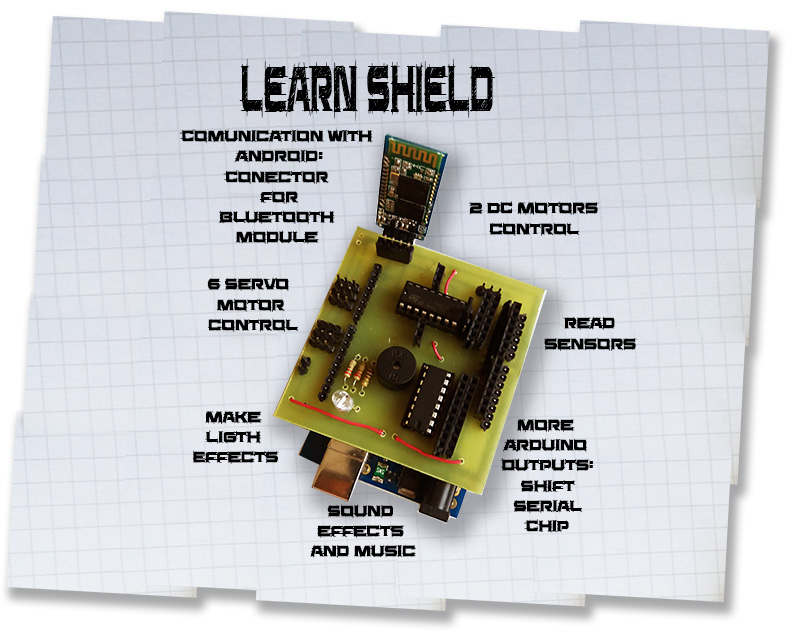
To simplify this step, we developed a board named Learn Shield. It has many features: RGB LED to create light effects, Speaker for sound generation, outputs for 2 DC motors and 6 servo motors, Bluetooth Android-compatible-module connector, 6 input sensors with pull-up or pull-down mode selection and serial shift chip to multiply outputs. This gives the same simplicity of GoGo Board in the Arduino platform. Now it is possible to make simple and very funny experiments, providing for the students a playful user experience. See example: AR2D2UINO – The DIY robot controlled by Android made with scraps.

LEARN SHIELD – BREADBOARDLESS SOLUTION FOR MANY EXPERIENCES
http://fablearn.stanford.edu/fellows/project/learn-shield-breadboardless-solution-many-experiences

AR2D2UINO – Build your own R2D2 with Arduino
http://fablearn.stanford.edu/fellows/project/ar2d2uino-build-your-own-r2d2-arduino-0

Connecting Children around the World to Explore Emotions through the Emosilla “Emotions Chair”

Ilaria La Manna is an extraordinary children’s educator and director of Fab Lab Argentina, who works with FabLat, an organization that connects children and educators learning and making all over Latin America.  She is in Boston taking some courses and generously offered to connect our Fab Lab to a network of Fab Labs doing an Emosilla or “Emotion Chair” workshop in Mexico, Peru, Costa Rica and Columbia on Saturday 5 December 2015.

Fair Foods of Boston, an organization that distributes food and makes colorful benches, donated several sheets of 4′ x 8′ plywood that our Shopbot-tery Guru Brad cut using the chair templates.  It took some creative collaboration with Ilaria to change up the press fit design to match the width of the wood that we had!

Ilaria started the workshop by exploring emotions with the six girls aged 4-8.  She used a wonderful slide show of photos that really engaged the youth.  Her blending of simple language, questions and humor created a learning environment where the children could comfortably explore the full range of emotions, not just the happy ones!

Then Ilaria asked the children to draw an emotion that they felt on a worksheet handout with colored pens and crayons. When they finished, we got on the Skype and they shared their drawings with children in other workshops around the world. The children then started building the press-fit Emosilla chairs.  I was amazed at how even the smallest ones LOVED to sand the edges and take mighty swings of the rubber mallet to pound the chairs together.  They were intrigued by the press-fit design and how to fit the pieces of the chair together like a puzzle.  Ilaria used simple instructions and explanations to help them feel confident enough to try the new tools with gusto!

Then some children painted their chairs with water-based paints (we got four colors — white, blue, red, yellow — and they mixed the colors they wanted in recycled plastic food containers) using cheap sponge paint brushes from the hardware store. Others went into the fab lab and created their emotion faces, using GIMP and Inkscape to digitally reproduce the design that they had drawn.  Then they lasercut their designs onto 11 inch circles.  They loved playing with the emotion faces as masks before we used wood glue to attach them to the chairs!

When the children needed a break, they spontaneously went over to the Skype panel and started interacting with other children around the world, sharing funny faces and gestures.  They were proud of their colorful hands.

as well as their colorful chairs, which they shared with other children via Skype in Latin America! 

I have to admit that clean-up was pretty time-consuming because little people find endlessly creative ways get paint outside of the plastic table cloths that we used as dropcloths.  But it was worth all the effort because, as Seymour Papert would say, the children had “hard fun,” thanks to Ilaria!

Once I was alerted to the concept of “hard fun” I began listening for it and heard it over and over. It is expressed in many different ways, all of which all boil down to the conclusion that everyone likes hard challenging things to do. But they have to be the right things matched to the individual and to the culture of the times. These rapidly changing times challenge educators to find areas of work that are hard in the right way: they must connect with the kids and also with the areas of knowledge, skills and (don’t let us forget) ethic adults will need for the future world.

-Seymour Papert (http://www.papert.org/articles/HardFun.html)

“I saved the world…multiple times!”: the powerful impact of youth teaching younger children and their peers STEAM-related activities

This is a guest blogpost by our talented Tufts University Tisch Summer Fellow, Michelle Nguyen, who conducted research with Boston’s Learn 2 Teach, Teach 2 Learn program.  Annually, our teen youth teachers teach 700+ children at over 25 community organizations. We have high expectations that our youth always exceed.  As our program name suggests, we also believe that learning is deepened when youth are engaged in teaching others.  A brief introduction to our 13 year old program can be found in our 2015 Project Expo program:  https://goo.gl/MCBUQL and https://goo.gl/UAu3Tr 

“I saved the world…multiple times!”
a quote from Marc, a youth teacher, about what his favorite moment was at SETC

Hello, my name is Michelle Nguyen, a current senior studying Child Study & Human Development at Tufts University. I’m interested in bridging human development and innovative science education. Over the past summer I worked at the South End Technology Center at Tent City in the Learn to Teach Teach to Learn (L2TT2L) program as a Tisch Summer Fellow. conducted this research project through participant observations, collection of “Star” data, teacher reports, and a final reflections survey. I was also a college mentor teaching graphic design and mentoring a group of youth interested in building a robotic hand. 

“Seeing all of the kids’ faces lighting up when they saw a squishy circuit work for the first time was my favorite moment” – a quote from the “Star” data in response to the question, “What is your favorite moment of L2TT2L?”

The above quotation really gets at what I’ve been trying to understand all summer. My research project sought to figure out: how can teaching younger children and their peers STEAM-related activities impact children’s and youth teachers’ self-efficacy (believing that they can achieve their goals). I came across three big findings:

Teaching builds leaders who grow into confident role models for children, who love the attention of the teenagers and want to be doing what the cool teenagers are doing.

There was only loud enthusiastic talk about robots amongst the children, sometimes interspersed with, “What is this?” and what they just ate for lunch.

Gabe, a first year youth teacher, stood in front of the 11 children hunched over a table with a few LittleBits in hand. He cleared his throat. “Hey guys! Okay, so now that you know what an input is, can you tell me what the input from us dancing to Cha-Cha Slide is?” he said. And immediately, it was silent for a moment, followed by children’s simultaneous talking, all trying to answer the question. Now this is when Gabe’s leadership skills really have to kick in or chaos may ensue.

Our youth teachers are challenged with multiple teaching environments and have to navigate through the chaos, or lack thereof, to really engage children in STEM activities. Through going out to multiple community centers and teaching so many different children in the short span of 3 weeks, youth teachers learn to adapt – allowing their innate leadership abilities to kick in.

Interestingly enough, this “significant improvement” in leadership abilities seems to wane as youth teachers had more experience with the program. Third year youth teachers reported still improving on their leadership among children, but fourth year youth teachers didn’t report any improvements.

What does this mean? As time goes on, youth teachers are gaining more confidence in themselves and stronger leadership abilities, leaving less and less necessity for improvement. Our youth who teach are in return seeing that their voices matter and are being heard, leading to significant development in their belief in themselves.

With this increased confidence and comfort with teaching, youth teachers become more fun, engaging, and develop a great energy in their teaching. They develop an attuned humor, interacting with each other and with children in teasing and fun ways that put children at ease. During the LittleBits activity, some children were a little shy to share their stories that they had developed using the LittleBits. Marc, a youth teacher, said, “Sharing is caring.” Evan added, “Look at this, you get to share.” In the same lesson, children were extremely enthusiastic about the next steps. One child said, “This is what we’re doing next!” Gabe teased, “Oh, you  spoiled it.” In all of these exchanges, children laughed and found more enjoyment in the activity. The youth teachers knew how to design and teach these activities in a way that was for the children.

Watching kids grow helps our youth grow positively – returning youth teachers often see the same children who they teach year after year grow  — helping them to grow creatively and fearlessly.

When looking at the “Star” data, there is a smattering of specific children’s names from various community centers mentioned. One time, when I had gone to do an observation at a local community center in the South End, Sammy, a college mentor, and I had casually talked about the children at the center. On our way walking to the center, she had told me more about the kids she remembered from the year before and about how it would be her 3rd year seeing them. She talked about them with such joy and nostalgia.

When we arrived, she assisted the youth teachers by telling them about the children’s previous experience with Scratch and joked around with the children. It was clear that her relationships with the children made the teaching session more joyful, humorous, and creative. Sammy and the youth teachers were able to extend beyond the basics and get children thinking outside of the box. At one point, a child was animating a monster dancing after a rock fell on its foot, because “when you’re hurt, you can’t stay still.”  

Children are greatly impacted by returning youth teachers. They get more personalized teaching and have relatable role models. Youth teachers are happier when returning to children they taught before, and can engage in more meaningful relationships. They get to see – first hand – how they personally can impact these children year after year. I call it reciprocal positive youth development. Furthermore, youth teachers really get to see the impact that their teaching has on their communities. It puts into perspective the meaning of the big picture.  In the case above, Sammy got to see the children become more knowledgeable about the technology and more creative.

Supervisors who regularly interact with these children also notice the impact the youth teachers have on the children. In response to the teaching  reports, supervisors often noted that they were “very impressed.” From their perspective, the youth teachers “gave kids a safe environment [in which] to think and share.” Because the youth teachers were  more comfortable in teaching and were able to build relationships with the children, “the youth learned a  lot [and] it felt welcoming.” They were “very patient  and pleasant with kids.” One particular supervisor commented, “All the [children were] amazed. The youth teachers did an awesome job with directions  and helping the [children] that did not understand.” Ultimately, “campers were engaged and  excited to  be there.” They wanted to keep  doing the activities  and even “some wanted to use their projects at  home.”

Failure? Big seeming unsolvable problems? No problem! – teaching builds better confidence in ones self, which in turn allows youth to take on bigger challenges, which in turn may prompt them to ask peers for help or teach other peers, which in turn builds more confidence.

Gabe, a new youth teacher mentioned earlier, and Thu, a returning youth teacher, stared intently at Gabe’s computer screen with furrowed eyebrows. They were faced with a seemingly impossible challenge: something had gone wrong in Gabe’s Arduino line coding. Then they began talking out the code, trying various ways to get it to work. Eventually, with each other’s help, they were able to solve the issue. A week later, Thu ran into a similar problem: her Arduino coding of a new motion sensor was going out of whack. She asked for Gabe’s help and the same process ensued, furrowed eyebrows and intent stares and all.

Gabe and Thu were able to teach each other and collaborate to take on big problems. A huge feature of collaboration, teaching, and learning through this process is building a greater confidence to ask for help – that way big problems don’t seem so scary because you’re not alone.  In the final reflections survey, youth teachers had written anecdotes about what they would do if they didn’t know how to teach an activity. Very few referred to reading the instructions. Most felt more comfortable relying on peers and learning from peers. Again, problems don’t seem so scary when youth have a community of supportive peers. That’s why youth learn best from peers.

Another huge impact of their teaching is that youth get more comfortable with failure. “It’s only a bump in the road – not a wall,” one youth wrote in the survey. Teaching children allows youth to experience different ways of failing, then getting back up and trying again. Youth can relate that to their personal experiences and persevere through their own problems.

What happens in return is that their fearlessness about failure translates to their teaching styles and impact on the children. For instance, GIMP Graphic design, similar to Adobe Photoshop, is often the hardest thing to teach. Youth at a community center were taught how to make animal GIFs. Youth teachers Marc and Lwam through their teaching styles, were able to foster confidence in the children. Afterwards, near the end of the lesson, Marc and Lwam decided to show the children a few, more complicated GIFs that they had made themselves.

One of the children said, “Woah! That’s really cool. You made that?” while looking at Marc. He replied, “Yep.” “I want to do that,” he concluded. Inspired and confident in their skills, the children weren’t as scared of failure and wanted to take on more complex projects, just like the ones the youth teachers have experienced.

These findings really support the ultimate conclusion: we should have more youth teaching. It benefits the children and peers they are teaching, and it benefits them. As shown, youth are building their confidence, seeing the impact they’re making in their community, and are then not scared to take on “scary” problems. These positive developments are what we hope to foster in our youth, so that they may go out and create bigger changes.

Making the world of maker education work for everyone: Listening to what youth say

I’ve been an education organizer for Learn 2 Teach, Teach 2 Learn for a dozen years. Many of our youth have moved on to college and beyond and sometimes I lose track of them.  So, late one night I decided to google “Learn 2 Teach, Teach 2 Learn” to see what came up.

To my surprise, I found two inspiring articles in The Riveter online magazine written by two youth teachers from way back in the day, Jasmine Rose-Olescu and Xia Josiah Faeduwor.  I write a lot of grant proposals about what I believe is important about Learn 2 Teach, Teach 2 Learn, but the truth about the impact rings even more true in the words of these youth.

The first article, “Technology is Child’s Play in the New Civil Rights Movement” traces one young African American’s journey through technology and making.  Jasmine write about her belief that, “it’s time to use technology to support the Civil Rights Movement’s next phase.”

As a young girl speaking about her longing to learn new technologies, she recalls her mother’s cautioning words, “There are people in this world who will underestimate you. They’ll say little things. They’ll doubt that you’re smart, they’ll doubt that you’re kind, some will even treat you like less than a human being deserves.”

Jasmine writes movingly about the importance of programs like Learn 2 Teach, Teach 2 Learn that,

reach as many people as possible by training highly-dedicated youth in these fields, who will then spark an interest in technology and science in the hearts and minds of younger students.

She talkes about the impact, saying,

having teenagers of color teach their younger counterparts of color not only increases representation in technology, but it also inspires the next generation to do the same.

In the second article, “Let’s discuss Learn 2 Teach, Teach 2 Learn,” Jasmine interviews another former youth teacher and current college mentor Xia Josiah-Faeduwor. Her words about the importance of our program touched me deeply when she said,

This program does a lot for marginalized communities, especially in terms of providing pathways to education. In the summer, we give children in urban communities a chance to learn from people who look like them, who are close to their age, and who can relate to them. That…is amazing because you don’t often [see] youth teaching other youth,…especially not in something that is perceived to be as complicated as technology. But, we teach kids the basics and, in doing that, we encourage them to teach themselves more. Us teaching them lets them know that there is a place for them in the STEM fields. That’s just what we do for kids that aren’t in the program as youth teachers or mentors. For the program members, you get the ability to be a leader, to be an innovator regardless of your skill level.

Xia sums up better than I could what needs to happen to get more of our youth of color and young women represented in STEM and in making,

We need to see more people that look like us doing technology. That way, technology can be seen as cool and, [as a result], more people would want to get involved with it. Another important thing is to talk to members of the community and to get them to talk to each other more about what they want, what they want to accomplish, and what they want to learn. When communities have these types of discussions, they see each others’ strengths, and they learn from each other and grow.

To attract and welcome those who are under-represented in STEM, along with the “technologies of the earth” — the technical skils and knowledge in STEM — it is important to infuse our maker education programs with “technologies of the heart” — those human beliefs and practices that bring out the best in us and enhance our relationships with each other.