Mindstorms is so rich of powerful ideas that it is really hard to choose and pick one or two…. Reading the book is like taking a walk among  almost every interesting concept I learned in my life, or, said in other words, meeting old friends again like Galileo, Aristoteles,Tarski, Poincare, Piaget and Bruner, all bringing new source of inspiration thanks to the powerful interpretation of their theory given by Papert. I’m particularly fascinated by Papert’s contributions about epistemology and its relationship with learning. It’s something related to my personal experience as primary school teacher with a background in theory of knowledge.
I’ve studied philosophy. During 5 years I used to spend my time enjoying the study of epistemology and logic of natural language. It was wonderful passing the day in the library, reading, connecting abstract concept, playing with theories, comparing paradigms, analyzing my own process of learning and using language.
At the same time I was starting to feel a strong interest for education as political practice. I discovered critical pedagogy and I got involved in several groups promoting child’s rights and new forms of teaching/learning. I decided to convert this political passion into a job mixing my theoretical background with new practical pedagogical knowledge, and taking the challenge of promoting educational change in low income public school.
At that time I didn’t know that my epistemological background and my desire for educational change were strongly related and they were part of my teacher’s “tool box”. At that time I was considering epistemology as something platonic, I mean idealistic, far from the ground, not a tool to use in education, but just a tool to understand the history and development of knowledge.
I was convinced that the change needed in education was more about participation, human relationships, respect, freedom, and cooperation than about the structure of knowledge. I didn’t understand yet that how we think about knowledge affects how we think about us.
The teaching practice made me discover a new reality, more complex, less ideological and more epistemological. I started to enjoy using models in order to help kids become conscious of their own mental process, or physical activity in order to work on logical topics. The separation between my theoretical background and the practice was gone forever..epistemology, mental experiments, scientific paradigms, modularity, cognitive science, history of science were everyday by my side, helping me making kids happy and comfortable about the knowledge they were building.
Below some Mindstorms ideas that I found very helpful for every teacher, not just math’s, to become conscious of the empowering effect of epistemology in learning and also to limit the production of “cultural toxins” and related damages on people.
- We need to promote a new sense of the child as a thinker, even as an epistemologist with the notion of the power of powerful ideas.
- It is necessary to encourage the child to become expert in recognizing and choosing among varying styles of thoughts, to acquire multiple epistemology in order to build his own knowledge.
- Procedural thinking is a powerful mental tool needed for multiple epistemology.
- A domain of knowledge is a community of powerful ideas.
- To know a domain of knowledge is much like coming in a new community of people. The teacher plays the role of a mutual friend who provides introduction.
- How we think about knowledge affects how we think about us.
- The discrepancy between our experience of ourselves and our idealization of knowledge has an effect: it intimidates us, it lessens the sense of our own competence and it leads us into counterproductive strategies for learning and thinking.
- The learner’s thinking is more like the mathematician’s than either is like the logical ideal.
- Powerful ideas help us grasping the world and have the capacity of helping us organizing our way to think about a particular class of problems. We don’t have to reorganize ourselves in order to use them. We put our skills and heuristic strategy into a kind of tool box- and while the interaction can, in the course of time, give rise to global changes, the act of learning is itself a local event.
- The importance of Tinkering: learning consist of building up a set of materials and tools that one can handle and manipulate.
 historian, I was struck by some of the assumptions about the development of computers. In some ways, his predictions about the growth of the technology were right on, albeit a bit quaint sounding, “Readers who have never seen an interactive computer display might find it hard to imagine where this can lead. As a mental exercise they might like to imagine an electronic sketchpad, a computer graphic display of the not-too-distant future. This is a television screen that can display moving pictures in color. You can also ‘draw’ on it, giving it instructions, perhaps by typing, perhaps by speaking, or perhaps by pointing with a wand….” Sounds like an iPad to me. What struck me was his assumption that using such devices would continue to require students to learn how they worked, and be, at some basic level, masters of the technology. In fact, the opposite is true. Just like other technologies in our lives, we know less about what is making the computer work, about the code behind the graphical interface, than we do about our cars, our refrigerators, or our television sets. So does this amazing technological progress reflect any of the hope Papert had for computers as learning and teaching devices. I think my answer is maybe. When we use the computers to read, write, play video, record audio and video, or access the web, we are using a useful tool, we are perhaps opening up a gateway into a revolutionary new expanse of available knowledge, but we are not doing anything to help a child’s brain develop patterns for math, problem solving, or debugging. However, when we use a few more creative tools in the classroom, movie making software and vector drawing programs come to mind from my own classroom experience, we do see students engaging in some of the same debugging activities that make LOGO so compelling.
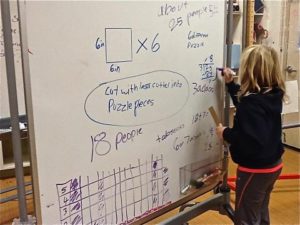 e might argue for the better, I teach 5th and 6th grade science through the lens of making and problem solving. In the two years that I have been testing this curriculum, I have noticed that not only have my students (including the self-proclaimed “bad at math” students), but I too am developing a new love and appreciation of math through the work done in our fabrication lab, or FabLab. Having read Mindstorms; Children, Computers, and Powerful Ideas by Seymore Papert I was reminded of my new found “crush” on mathematics. Curiosity inevitably set in while reading Mindstorms and I wondered: Can we be learning math using tools that speak to the unconscious learning process? Can we build a sense of awe for mathematics using problem solving and making? And lastly, am I “teaching” math now, if the curriculum of problem solving and engineering is helping kids to see the beauty of math? My goal for this blog is to get a conversation going on how using Making in Education might get more students to love math for life, because doing so simply opens more doors for our students.
 I like when Seymour explain about the process to develop his writing as the analogy to new perspective to look at learning. The first ‘unacceptable draft’ that leads to revision with ‘critical eyes’ and kind of self-assessment and develop work from feedback into presentable form, these steps made me look at the learning process in the different way. Looking at the mistakes as the opportunity to learn and develop not just for marking as failures is really the key change.