Gears and fears – A reflection on Seymour Papert’s essay ‘The Gears of my Childhood’

When reading Papert’s essay I was fascinated by the way that Papert creates the link between his earliest childhood memories to his experience of learning and how these experiences shaped the way he would forever interpret the world around him. In the article he describes how his love of automobiles helped him to give context to the gears in a construction set. The gears then became a ‘comfortable friend’ for him to experiment and explore mathematical ideas. This concept of building on learning and developing strong abstract representations to think with really interests me and is something I would like to explore further here.

My own personal ‘gears’ story began with music in particular the Yamaha VSS30, a sampling keyboard used primarily by my brothers to play expletives in 8bit samples across 32 polyphonic keys, but there was more. I was fascinated by the way that audio could be looped and manipulated using effects to create new and otherworldly sounds.

The Yamaha VSS-30

I loved electronic music, I would spend my pocket money on records and cassettes with no concept of how this music was created. At no point did I consider that the sampling keyboard had anything to do with this new futuristic soundscapes that I enjoyed so much. Something so obvious now seemed inconsistent then. I would watch the BBC music show ‘Top of the Pops’ religiously, and try to figure out what was going on. I would write to my favourite musicians to try and find out how they created their sounds, if I was lucky the PR staff would send me a signed photo of the act.

Image of the band The Shamen - 1993 The Shamen – 1993

Computer technology and music weren’t two things that I had made a link with. During this time I would visit the local Bainbridge’s department store and see the latest ‘tech’. I was amazed at a computer’s ability to display a photograph, so the idea of the machine’s potential was not clear to me. It wasn’t until a few years later that I managed to sneak into a nightclub one Tuesday evening after school, I was awakened. I had recently bought the album ‘Homework’ (ironic right) by Daft Punk and they were headlining. That evening was the best homework I would ever have. I stood on the balcony in amazement as I watched visuals played via midi keyboard connected to an Apple Mac computer. On stage Thomas Bangalter and Guy Manuel played an array of electronic instruments the likes of which I had never seen before but most importantly, I saw people enjoying and interacting with technology in ways I had never even considered possible.

Image of a Newcastle Mayfair ticket | Daft Punk - Daftendirektour 1997 Daft Punk – Daftendirektour 1997

From that day I was hooked, analogue musical instruments were relatively inexpensive (in comparison to today’s prices) and they weren’t too hard to come across. I built a small setup of my own. I began to learn about waveforms, patterns, synchronization and sampling through play. I was inspired to learn about video, animation and sound. To this day I apply these principles to my work and not just in the context of music.

At the same point in our lives I found my love for sound, and Papert ‘developed an intense involvement with automobiles’ we both had found our favourite pastime. I was intrigued as to what an ‘Erector Set’ was so I decided to take the risk of Googling it. An ‘Erector Set’ advert from the 1930’s reads;

‘Hello Boys! Look at this giant power plant! You can build it yourself with the great new Erector!’
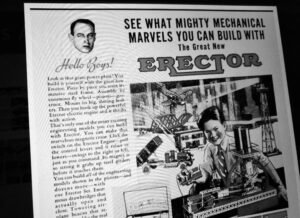
Image of Erector set - 1930s Advertising Erector set – 1930s Advertising

I was confronted by an uncomfortable thought what if my experiences had been determined by my sex, race or gender? From an early age Papert had ‘developed an intense involvement with automobiles’ but what if that hadn’t happened?

When considering Papert’s article ‘The Gears of My Childhood’ and reflecting upon my own experiences my initial thoughts were ‘what if Papert wasn’t exposed to cars as a child or didn’t have the opportunity to play with toy gears, or even, what if he wasn’t a ‘he’, what then?

Of course we can look at this advert today and suggest that ‘it’s of it’s day’ or ‘things were like that then’, but have things really changed that much, have they? Do we still see gender bias in ‘transitional objects’? Of course we do! How many people have missed learning opportunities by not being given a toy or ‘transitional object’ because of their sex?

If you were to walk into any major toy store you will see a pattern, the ‘pink aisle’ and the ‘blue aisle’. Where would you most likely find a ‘Meccano set’ or an ‘engineering toy’?

Research conducted by the Royal Academy of Engineering and WISE has found that just ’12 percent of engineers in the UK are women and they earn around 11 per cent less than their male counterparts, on average’.

I don’t want to oversimplify the issue or suggest that toys are to blame for this, but through my own experience, electronic music has the same issues. In 2020 the top 15 Highest paid DJs in the world were all men. It is widely accepted that children identify differences between the ages of two and three.

‘A modern-day Montessori might propose, if convinced by my story, to create a gear set for children.’

Seymour Papert – The Gears of My Childhood

I think this could be a positive conclusion; let us build a gear set, let us create a sewing set, let us create a whatever set! But let us not impose gender stereotypes upon these objects.

Image of 8-Bit Cross Stitch - Make Stuff North East Activity 8-Bit Cross Stitch – Make Stuff North East Activity

Nostalgia plays a pivotal part in Papert’s story, without his experience of automobiles and with gears and the ‘Erector Set’ Papert may never have discovered his ‘comfortable friend’. We may never find our own ‘comfortable friend’. I hope that as an educator one day I can help someone to find their own ‘comfortable friend’ and not be constrained by the vision that our modern patriarchy imposes.

I Keep Learning; My Reflections on Dr. Papert’s “Gears of My Childhood”

Growing up, I loved school. Not because it was the most fun place to be, but because I enjoyed learning. I started school early as compared to my peers and that meant sometimes enduring bullies or kids who loved to mock the “tiny ones” in class. That aside, I always looked forward to school and the new things that awaiting my exploration. I read books to learn English, which is my third language. It was not very easy as we barely owned a library at my remote village school. Most books were donations from European and American schools which meant a huge cultural difference between the content in the books and my actual life experiences. As much as it was strange, it also presented the opportunity to understand that there are different cultures out there with kids my age trying to learn the same language.  

When I was in my third grade I visited my aunt, who was an English teacher at an urban school. With her, I found a collection of books, mostly supplementary readers recommended by the Ministry of Education in Kenya. The interesting part was that these books were written by local writers. The examples made more sense and found that I was reading faster and understanding better because I would read about things I could associate with. I know I was too young to realize I was learning faster but that experience helped me learn English better. Fast forward, since most of the lessons in Kenyan school were taught in English, I could better understand Mathematics and the sciences. I have always been a steady learner, sometimes slow but when I get there I trust my expertise in a given topic and would trust myself to explain it in the simplest way. As Albert Einstein famously put it ” If you can’t explain it simply, then you don’t understand it well ”  

Two decades later, I was at The University of Nairobi studying Electrical & Electronics Engineering looking forward to working in a huge corporate probably in the energy sector or telecommunications space. Upon graduation, I did work for a telecommunications firm. I grew as a design engineer. I learnt quickly while at work and mostly I enjoyed how design concepts translated into tangible solutions for the clients. I did not stay long in the practice because I struggled to fit in the work culture and most of my frustrations could not go away unless I changed jobs. That is how I found my way into the Edtech space in Kenya and I have loved it since. I joined Global Minimun Inc as an intern and for the first time, I was in an organization that explores a different kind of learning which is learner-centred. I learned how to question my assumptions about learning and became keener on giving my students the freedom to decide how they want to learn. 

I enjoy most how project-based learning enables students to grow their creative confidence and make solutions they want for their communities. In Dr Papert’s Gears of My childhood, he explores how individuals learn depending on models that are available to them and how they learn those models. Further, the article explains why different people understand different topics better than others. Looking back at the Gears of My Childhood, I see how through making, learners can build knowledge and develop models that enhance their understanding. It has been 4 years in the maker education space and invention education and throughout my work, I have enjoyed learning alongside my students. Most of my students come from communities with very low resources and sometimes they have very minimal exposure to computers and technology in general. However, I have observed that, by providing these resources to them in a setting outside of their usual school routine, they are able to tinker and create exciting learning experiences. 

It is my hope that more students will gain access to similar resources through maker education initiatives that are now growing in Kenya. This way, students will be able to benefit from technology as an instrument of learning and innovation. At a young age, maybe they will discover the gears of their childhood and gain the confidence to freely explore their areas of interests as they build their careers and beyond.


Motivation – My correlation with Seymour Papert’s reflections

These are my thoughts on the essay “The Gears of my Childhood” by Seymour Papert.

There is an acient story about a young man named David, who defeated the mighty giant Goliath in an epic battle. Maybe you know this story well or maybe you have only heard about it.

David was small, had no resources and was alone in this fight, but he did something that changed his story: he put his heart into that duel. And he won the battle.

But why did I remember David?

Papert’s story, which talks about the way in which he put his heart in his relationship with the gears and how that changed the way he saw the world around him, reminds me of David. This story reminder us that in life what we do need to have meaning and motivation. That is an important reflection for us, both as educators and as apprentices. Papert’s story also reminded me of my own story. And you must also have memories of someone, or something, that changed your view of the world.

Some years ago I had the opportunity to read an article by the Brazilian writer Rubem Alves (1933-2014), which was published in a newspaper of great circulation in Brazil. In that article he quoted a phrase that touched my heart: “curiosity is an itch in the ideas”. That phrase became the gear of my life as an educator.

As a mathematics teacher, I have always heard the same question from my students: “Where am I going to use this formula in my life?”, usually related to the Bhaskara formula ¯\_(ツ)_/¯. It is a valid question, especially if that student has no interest in acting in the field of Mathematics.

I would love for my students to create connections between the real world and Math. For a teacher of this discipline, it is wonderful to have students who, like Papert, have models that inspire them and make them see meaning in what they do. It is thought-provoking how Papert reports that he understood well the functioning of gears and the structure of differentials, including making connections between them and mathematical equations.

But that phrase caught my heart: “curiosity is an itch in the ideas”. I remembered my childhood, how I used to ask questions and how curious I was. And I thought: “how can I create a space that fosters my students’ curiosity?” The story of the author Rubem Alves inspired me. I concluded that my classes should be more constructionist, that is, more exploratory.

One of the first projects I developed with my students was the Mousetrap Car. This project became another gear for me. I started to see different applicabilities for the Mousetrap Car project in Maths and Science contents. During classes, with their smartphones, the students, engaged and motivated, filmed theirs Cars on a defined trajectory and used calculators to estimate the speed of their prototype.

Shortly afterwards, I expanded my activities to educational robotics with LEGO Mindstorms and to the electronic prototyping platform Arduino.

At that point, I also developed interactive Maths quiz projects with my students, using the visual programming language Scratch, and worked on the concepts of Computational Thinking. And, the itch in the ideas that I wished my students had started to take hold of me. Thus, I became an educator who researches new methodologies and technologies for teaching Mathematics.

In 2018, I followed the implementation of the Maker Space at Polo Educacional Sesc, where I am currently a Maths teacher. I collaborated with the creation of the course called Designer in Digital Fabrication (Figure 1), an initiative whose objective was to empower our students to use the resources available in our new installation (3D Printers, Laser Cutter and other prototyping resources), through the Design Thinking strategy.

     
Figure 1 – Designer in Digital Fabrication training course

Among the actions in which I engaged in favor of Maker Education, I began to multiply my activities in courses of experimentation and training of educators (Figure 2) from our net of schools. These actions inspired me to inspire and became the differential in my professional life.

     
Figure 2 – Training of Educators

By merging low tech resources and high tech resources for hands-on activities, my eyes were opened to a new perspective on math teaching. That was how in 2019 I created the Maker Math course.

Teaching mathematics through digital fabrication, educational robotics and artificial intelligence is the guiding thread of this course. Mathematics, which exists in all the just mentioned technologies, allows the student to develop skills and competences through the development of projects of interest.

Stimulating curiosity and promoting incentives for the student to put their heart into what they are learning is a good start for a meaningful and enjoyable classroom. The giant Goliath, for many students, represents their efforts to create a connection between what is taught at school and the real world.

But there is nothing like strong motivation to help learners to move on and overcome difficulties. The term motivation is derived from the Latin word movere, which means “to move”[1]. Motivation can be defined as “the forces that act on or within a person that cause the awakening, the direction and the persistence of the voluntary effort directed towards an objective”.

Papert was moved by his gears, and they reverberated in a life focused on research, innovation and the inspirational Constructionist theory.

[1] https://www.encyclopedia.com/management/encyclopedias-almanacs-transcripts-and-maps/motivation-and-motivation-theory

Find your unique gear–The Reflection of Dr. Papert’s “The Gears of My Childhood”

There is a Chinese saying that goes: “You may figure out a person’s future from his childhood.” I think it applies well to the experience that Dr. Seymour Papert shared with us in “The Gears of My Childhood”.

It seems that all the important turning points which Dr. Papert encountered can be traced back to the first gear or gear system that brought him joy in his early childhood. And it was the starting point which drove his development as a human being and a researcher.

Dr. Papert’s experience makes me think that it might be a human natural instinct to love fiddling with objects and then it becomes a drive and a prompt to explore the world around us. By building things, we are also building the connections between us and the physical world.When it happens more frequently, then it forms a way or mode of thinking. Based on that, one can find the law behind what the superficial phenomena are and discover various possibilities.

“By the time I had made a mental gear model of the relation between x and y, figuring how many teeth each gear needed, the equation had become a comfortable friend.” For someone like me who is not that good at Mathematics, I am still not able to thoroughly figure out how the equation relates to the mental gear model. However I can emphasize the thrilling feeling when me and my student “clicked” and discover something new during the making project. It echoes with what Dr. Papert told us in the Foreword of his book:“Assimilating equations to gears certainly is a powerful way to bring old knowledge to bear on a new object. But it does more as well.” As for me, I feel that the Making projects has a powerful affective aspect of assimilation.

“But I was painfully aware that some people who could not understand the differential could easily do things I found much more difficult. Slowly I began to formulate what I still consider the fundamental fact about learning: Anything is easy if you can assimilate it to your collection of models. If you can’t, anything can be painfully difficult. Here too I was developing a way of thinking that would be resonant with Piaget’s. The understanding of learning must be genetic. It must refer to the genesis of knowledge.”

In this case, I guess every child or every person has their own unique gear. But can everyone find their “gear”? Or can we help them to find something that THEY love and can be applied as a bridge to understand more abstract ideas and the world. It seems that unique gear can’t be cloned or taught, but must be discovered.

Through making, I found that one of my gears is to open to discovering new possibilities. While embracing the uncertainty, the projects inspired both myself and my students. Four years ago, my former students did a mini “exhibition project” based on the theme of the “Chinese culture” unit in my Chinese second language class. Despite of the limited time and materials, the products that students made were out of my expectation. That experience gave me the first taste of the charm of making.

What making projects brings is like the turning of different gears, some are turning one way, and others are going the opposite way, yet they work together and also bring new thoughts and ideas and a greater force in teaching and learning. That’s why when I was introduced to “Makerspace”, I immediately wished to join it and make it “clicked” into more learning experiences.


Here follows is one of the products from my “pre-Makerspace” project:

1.Exhibition pavilion (one side is a clocktower shape of western style and the other side is of a Chinese pavilion style )

Papert reloaded- Computers are the new gears

Italy, March 2021. We are in the middle of a pandemic, schools are closed and, as a technology teacher, seeing children every day as Google Meet boxes is both hard and fascinating. Hard for obvious reasons: everyone is trying to talk, chatting, using the tool they have in their hands (and forced to use it) to exchange ideas, organize (online) playtime together, look at the games others have at home, all while the teacher tries to get them to do something.

However, it is fascinating to note the children’s great resilient ability to always turn what they have into a way to do what they want to do, depending on their ideas: they have learned that every Google Meet has a code, so if the teacher’s has one they can create another too, and get together online to talk and be together, from a distance.  Wanting to do something at all costs has, in some ways, “forced” them to adapt the medium to their needs, going above and beyond to help each other.

This situation reminded me of my first experiences in approaching technology when I was a child, especially computers. In my parents’ house there was only one desktop computer, because my father (IT specialist) had his own personal laptop, so he had assembled a desktop one to use at home. In the afternoons after school, my brother and I wanted to use the computer to play games, but without getting caught… That’s why I looked for what solutions there might be to keep us undetected, and that’s how I learned to clear history and cache, open anonymous windows, put everything on my portable USB stick, change passwords, etc. It was fun watching streaming series, chatting, playing videogames, and then deleting most of the traces I left behind! Of course I was convinced that I always deleted everything, but today I can imagine that my father knew a lot more than I did, and was able to see what I was up to anyway. But more than the practical skills I acquired, the most important lesson I learned was to analyze the problem in front of me, and try many small solutions until I found a way to solve (or get around) it. It’s the same thing I try to make my students get experienced: it’s my first time as a teacher in a school, so many things are still new, but I think it’s fundamental to start from a “constructivist” approach to the problems we are now facing in school. In teaching technology, it is essential to develop, before any skill in the use of any device, an elastic and “resilient” approach, which allows not to be knocked down by the first difficulty in using an app, a device, a program, etc.. I’m experiencing firsthand the effort and passion behind this goal: it’s hard to help children at a distance, to explain to them that they don’t have to give up if the program doesn’t start or if the connection is slow. The way I have found to do this is very simple, and can be summed up in the word “LISTENING”: when you approach a digital tool you have never used before (whether it be a computer, Scratch, Google, Arduino, etc.) for the first time, the first impression is often “disorientation”, due to not knowing exactly where you are, and this impression risks irreversibly conditioning any future experience of approaching technology. As Papert said, we need to create and take care of the conditions in which the learning process takes place, because the creation of cognitive models is closely linked to the experience associated with them. Therefore, it is important to pay particular attention to the context in which the experience takes place, and to design it in such a way that it can be as ideas generating as possible and not an obstacle. This means thinking about the tools you want to use, trying them out, experiencing them firsthand to evaluate their possibilities. Papert rightly declares that the computer is a tool that offers countless possibilities: however, as with gears and mathematics, it can be hated right from the start if we don’t create the conditions to be able to experiment with it in a constructive way.

When we approach an instrument with children that they don’t know, the first thing I try to transmit to them is curiosity: by putting them in front of a challenge or a problem, I try to make them find their own way to the solution, supporting them when they ask for help or explanations. Exploring unknown tools in a creative and playful way creates a positive model linked to that type of experience, which will become an essential foundation for future learning processes.

Design process – from paper to prototype in schools (Workshop designed by FabLab Valsmaoggia)

Reflections on Seymour Papert’s article “The Gears of my Childhood”


I have read Seymour Papert’s article “The Gears of my Childhood” before and it always inspires the same questions. I feel I have only found a partial answer at the moment: What is meaningful? What triggers in children and/or adults the sense of involvement that allows them to “fall in love” with a project?


I remember exactly when I discovered computer programming, I was 6 years old and my father had given me a Commodore 64 for my birthday. It was not easy for me to use it, but I remember that I had recently learned to read and I found a guide to the basic programming language in the box with the computer. Following the instructions I was able to write and print (the printer … such a wonderful thing!) the recipe book that my mother had in the kitchen. 


I experienced a great satisfaction in creating  working code that did precisely what I had imagined. I also remember that I tried a drawing with asterisks, a dog as I recall. After that  we had other computers with other operating systems and there was no longer the need to write programs to write a text or draw. 


Love blossomed again at university with the Computer Science exam. The exercise of imagination in my head where I can foresee scenarios and imagine how to realize them has helped me in different areas of my life, for example using recursive cycles to break down complex activities into simple structures or a routing algorithm to organize daily activities.


Now I teach in a primary school in a city near Rome and I try to offer to my students different experiences so that each of them has the opportunity to find what is meaningful to her/him. In my school we are lucky enough to have a makerspace and I often found myself wondering what activity to propose. A few years ago I noticed that depending on the project, not everyone felt involved. Some dedicated time, carried out research, and constantly improved their artifact. Others, on the other hand, were building a sloppy project, working in a hurry to be able to move on to the next activity. It was a difficult balance, because if on the one hand a well-defined project did not emotionally involve the whole group, on the other hand, even very young children (about 6 years old) could not be expected to have the skills and creativity necessary to start from scratch. 


This was the situation I was in before I came across Papert’s explanation of how Logo was designed: that it has a “low floor,” allowing children to engage with minimal prerequisite knowledge, and a “high ceiling,” -offering opportunities to explore more complex ideas. I think this aspect is what fascinated me about computer programming, the possibility of having low floors and high ceilings. From that moment I always try to suggest activities that can then be accepted or declined according to everyone’s interests. Other goals are to offer a space that can be explored with very relaxed times and to help them with stimulating questions to find their project idea. Sometimes we start from the materials, for example glitters or rainbow straws, other times from an idea found on Pinterest or seen the day before on Youtube … who knows!


Another interesting aspect that I found in the article is in the following sentence: “Anything is easy if you can assimilate it to your collection of models”. This construction of models happens when people have good, creative experiences. I believe that our mission as teachers and educators is to offer opportunities to our students, to propose experiences, challenges and learning environments that can allow everyone to discover their own gears. No one knows what it is until they meet them. So what actions must be taken to be able to do this? I believe that a synergy between teacher and learner must be born such as to abandon the “programs” that ignore the participation of the learner and give way to the co-planning of activities.


I remember that when I was in front of my Commodore 64 I did it by choice, no one ever asked me to do it or told me what to do. and I believe that the choice to start a project and the enthusiasm in designing and, deciding what and how to do it is an important detail that makes the work meaningful.

Time to tinker

Gears!

What comes easy to you?

Love it, show it, Share.

Connect, evolve, and have fun!


When Seymore Papert tells his childhood story of his love for gears. He tells a story about a system of tangible objects that became obvious to him, though it would seem complex to others. Through play and love for the turning and interaction between the gears he gained a scaffold to learn other knowledge from. Papert, for example, mentions an experience where he understood multiplication and variables through his mental image of how gears worked.

The point here is not that every child would benefit from learning how gears work. The learning experience is very personal. His love for gears, physical objects he could manipulate, experiment with gained him a mental representation of the mechanics. 

What can we learn from this? 

I think that it is difficult in most classroom situations to see the gears of the individual pupil. Some kids are explicit about their special interest or excel in obvious ways. But many of us, might not even be aware of our own gears. I, for one, have trouble naming my own gear. Maybe it is because I am more of a generalist. I don´t know. I have always loved many different things, and will rather learn something new, than master what I am already able to do. Of course, that is not true in every aspect. As to teaching, tinkering and creating music I have used a lot of time, but I will not say that I have mastered it — yet.

I believe that we need to help our students discover their own gears, and help them channel it into their projects whenever possible. I also believe that it is a teachers task to help students develop new gears. Another task is being aware of the way you learn. If something is easy to you, it is natural to believe that it is also easy for everyone else, but that is not the case. We need to help our kids to discover their strengths!  

There are a few things that could make this happen. Knowing your students! Not just on a factual basis but also on a more personal basis. How would you otherwise discover, what makes them tick, what they love, who they are?

Time, patience and more unsupervised time! 

It takes time to build relations that are genuine. And it takes time for the child to immerse oneself. I sometimes worry about the amount of unsupervised time that each child has for themselves during a day. In Denmark the schooldays a few years ago were made substantially longer, basically to perform better in PISA and other tests. Though the intentions were to reform the school system, reality was “more of the same” a lot of instructional education. Fortunately we have solid traditions for teaching project based but that part is rather small compared to what their time is spent on. Especially in 8th and 9th grade, which concludes our basic school, the teachers often depend on instructional teaching, because they have so much knowledge they need to cover before exam — or that is the standard argument for not working more with projects.   

When I was a child the schooldays were about 4-5 hours each day including breaks. I had a lot of time after school on my own or with friends. There were no adults present to manage our activities, and we did a lot of tinkering in that time — sometimes rather dangerous things, but that is another story, for another time. That extra time is now taken away by our school system and filled with textbooks. I strongly urge all the schools, I work with, to make way for more project based, constructional, student-centered learning. The after school programs, which most kids attend because the parents are working, also need to be a more inspiring place to spend your time. A place to tinker, do what you love, make stuff together with other kids and have fun! A place where the adults know when to leave kids alone, and when to help and guide them.

Think of your favorite childhood game or activity… Where was the adult?

True, meaningful play comes from within the child – not from an adult telling you what to do!

Make sure they get time to tinker!

Reflecting on Parpet’s article “The gears of My childhood”

When reading the essay by Seymour Papert, “The gears of my childhood” to the online article as the preface to a book Mindstorms: Children, Computers and Powerful Ideas (Basic Books, New York, 1980), I couldn’t help reflecting on my own purpose and work with education.

For me, the story of the gears is also about finding the things that motivate me. I am passionate about finding ways to make it possible for my students to be protagonists of their own history by having contact with the kind of learning  that was engaging and meaningful about constructivism and also the lessons of Paulo Freire. So, when I started working with scrap robotics for children and young people from underprivileged communities, here in São Paulo, Brazil, I wanted to provide them with an education that considered creativity, problem solving, but that also  involved students.

 My purpose was to show them that the universe of programming and robotics was also for them. It was necessary to reinvent paths in education so that it could consider experimentation, doing, creativity and that we could  also find meaning in school through the maker movement.

When making an analogy with reading, I realize that the gears of the current education need to be revised and through the maker movement it was possible to do it, to give a new meaning to the areas of knowledge, to bring experimentation and playfulness to the teaching and learning process and on working with active and innovative methodologies to be able to give my students the perception of new meanings, to offer them new paths.

 That was possible, and the work brought solid results as  I played the role of a  teacher in the shoes of the learners and mediator of the process at the same time. Therefore, Not only did we find paths, but we have also created a new teaching methodology that today has been  transformed in a public policy that impacts 2.5 million students and that has solid outcomes as the creation of the São Paulo Basic Education Innovation Center.

Buildtopia

A little glimpse…

Coming soon: A bit more information

Reflecting upon Dr Papert’s work “The Gears of My Childhood”

This is a personal reflection of Dr. Seymour Paperts work called “The Gears of My Childhood”.

I’ve been in Maker education now for about 16 years and I truly believe that learning should be done through an array of modalities. I find that in my own life, I tend to learn better when I hear things and make things based on what I see and touch.  I also know that I’m a visual learner, I like seeing things in front of me. I like to play with objects and ideas to see how they work or relate to other ideas. 

My personal “Gear” story happened when I was in grad school. I took a generative art course where we used computer programming to make animated pieces of art. There was one project I started to play around with sines and cosines to make my animations grow and shrink to make the piece look like it was breathing.  It was through that tinkering that I understood what cosine and sine were. It was also my first glimpse of what I wanted to achieve in my career, taking math which I know is so beautiful, and applying it to teaching in a way that made sense for others. Learning trigonometry in my junior year of high school was rather bland, it was just going through the motions of solving problems but not understanding what the point was or having an experience to grounds my ideas.

Currently, when I co-teach Trig Functions with @KateBelin, we start with students building a Ferris wheel and looking at the motion between the bottom of the ride to the top of the ride. This provides a guidepost for the experience to study the concepts. But I digress, this story is about my “Gear”. Anyways, It wasn’t until I started making art with trigonometry did I feel like I understood the concepts. Now I know everyone has a different experience latching onto different interests and ultimately different ideas. Dr. Pappert spoke of this when he stated “ I fell in love with the gears”. My visual representation of sine and cosine and what they did to my animation was the vehicle for me to understand concepts deeper. Sure not everyone is going to understand math through Ferris Wheels, gears, or through generative art, but I think this is why I enjoy teaching Making in the classroom. 

Making is an experience that connects different ways of learning to make both new ideas and objects. There’s something mystical to when an idea just clicks through the experience.  What makes it very special is how intimate these ideas form to the individual.  When people are Making, they are engaging with the materials all the while they are forming new ideas. Everyone is making their own connections and meaning through the process. I believe that if Dr. Papert could see a Maker classroom he would appreciate the work being done. His notion about the computer is how I see Making,“ it can take on a thousand forms and can serve a thousand functions, it can appeal to a thousand tastes”. 

As I write this blog post, thinking about Making and Constructionism learning theories, I think back to my daughter’s Parent-Teacher conference we just had. She is in second grade and in a week she will have been in remote learning for a whole year. She has done more remote learning than in-person instruction in her entire elementary school career. She is a lovely person, of course a parent would say that, but in truth, she loves to learn, create and imagine. Sadly we spoke with her teacher about how the science video lessons are not engaging her. Her class is learning about simple machines and will ultimately create a bridge from these experiences, but they are learning about simple machines through watching videos.

We chose this school not so much for the “Academic Rigor” but for the holistic curriculum and the level of project-based experiences in the classroom. As a teacher, I also know the challenges of trying to do engaging remote instruction and stretching one’s own creativity to include hands-on work. Anyways, I wanted to communicate to the teacher that something was missing in the remote instruction, both my wife and I believe it’s the lack of engagement and socialization but there was also something else missing in the equation specifically with the engagement piece. What would get my daughter into learning simple machines? What is her “Gear” in all of this? 

It dawned on me today after she went to a fellow peer/friend’s home, a girl that she visits every Thursday to do science and socialize. She came home so happy to show me her Catmobile that she built with recycled boxes, straws, and bottle caps after studying wheels. She also was proud to show me charms she made with yarn, bottle caps, and hot glue. At that moment I realized what was missing, the Constructivist piece that attracted us to attend this school. With remote instruction, she was missing the hands-on learning and the magic of making connections between new ideas through the hands-on approach. I whole heartily believe that she learned more about wheels today than she has watching videos about wheels. Also watching her light up, beaming proudly, at what she made helped me see the glimmer of her love of learning again and of her own gears turning. 

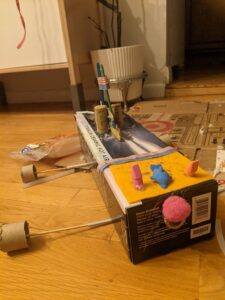
“Catmobile” By Zoë Bringas