The Techie Ugly Christmas Sweater Project: Part 1

ugly-christmas-sweater

Ugly sweaters seem to be pretty hip these days.

Wal-Mart sells them, Target sells them.  There‘s even a shop in my town where you can “uglify” your very own Christmas sweater.  And yes, we have an ugly sweater contest at our school (that I plan on winning by the way). Last year I made a pretty nifty one and this year I made final unit out of this idea.  Yep, my advanced engineering class is pushing toward the completion of some pretty sophisticated ugly sweaters.  Some blink, some play music, some might even look like the Grizwolds house.  One has car horns on it and yet another, a Christmas trivia tree!

One might ask, “Why would you do such a project?” and I might answer with a Christmas quote like, “Bah humbug!”  I mean do you all know that, “The best way to spread Christmas cheer, is signing loud for all to hear.”?

The truth is that this has been an amazing project.  Students, driven by the desire to create something amazing, have learned a ton.  Makey Makey, Soundplant, Scratch programming, more Arduino lines of code than I can count, flashy LED, e-textiles, laser cutting, soldering, I could go on and on.  The room is abuzz with excitement -the warm smells of gingerbread being cut on the laser cutter fill the air. Kids helping each other, sound bites of various Chirstmas music and movie clips playing in the background, and students helping each other troubleshoot their projects.

All I can say is that well… it’s a wonderful life, really wonderful.

So, how can you create your own interactive techno ugly Christmas sweater?  Well, here are my recommendations for a simple but effective techno sweater (part 2 will show you how to make it even more like the Griswolds but let’s start with the basics).

  1. Get a really ugly sweater.
  2. Get a laptop that you can carry with you (if you want to go completely mobile).
  3. Get a Makey Makey and some conductive ornaments, or other conductive bling for your sweater.
  4. Download Soundplant or use Scratch (to map keyboard keys to soundclips, songs and such). -see resource section below.
  5. Layout your sweater and glue down conductive elements to the front.
  6. Turn your sweater inside out and mount your Makey Makey to the inside, run wires to each conductive element on the front of your sweater.  -Just duct tape them to the inside since this is probably temporary.
  7. Link your favorite audio clips or songs to the A, S, D, F, W, SPACE, and arrow keys in SoundPlant or on Scratch.
  8. Connect yourself to the Makey Makey ground (I used a gator clip running down my sleeve to my wedding ring but you could also connect to a metal bracelet, watch, etc.)
  9. Test you sweater.  It should play clips or music when you touch your various conductive elements on the sweater!
  10. Go mobile!  Just make sure your computer doesn’t go to sleep when the lid is shut, keep it attached to the Makey Makey with SoundPlant or Scratch open and then put it in a Christmas gift bag.  Run the USB cord up inside your sweater, add some gift tissue around the top and you are ready to go.
  11. Have a fun time!
  12. If you want to add twinkle, try adding some LEDs, or some blinky LEDs with a LilyPad or Gemma.  Cotton balls make nice snow and diffuse the light very well while hiding your LEDs a bit.
  13. Look at my next blog post on how to make your sweater beat the Griswold’s house with your Arduino timed light display!  Oh ya, it’s going to be fun!

Resource links:

  • Makey Makey plus Soundplant- This combo is the one-two punch of an awesome interactive ugly sweater.  If you really want to go crazy, put in 2 Makey Makeys (just have to reprogram the keyboard map on one of them).
  • If you are using a Mac you might want to download NoSleep too.  This way you can close the Mac, and still have it run Soundplant.
  • Add some basic twinkle- check out Adafruit’s Gemma or SparkFun’s LilyPads.
  • Want a working fireplace?  Download the Digital Dudz app for mulitple Christmas sweater movies that can play on your phone.

Hot off the FabLearn Fellow presses

While I realize the “hot off the presses” is not an accurate metaphor these days, it seems appropriate! The recent FabLearn Fellow blog posts have created a lot of room for discussion around the topics of fabrication, making, and design in museums and classrooms. Please comment and add your voice!

A brief overview of recent posts:

In 18th Century Buildings, Vector Drawing, History, and Math, Heather Pang explores how a project designed to be a simple skill-builder evolved into something more.

Christa Flores tackles Making for Making Sake? or STEAM for 21st Century Job Skills? weaving in educational philosophy, economic policy, and reaching out to FabLearn 2014 Netherlands attendees to create a global conversation.

Avoiding Cookie Cutters by Keith Ostfeld muses on redesigning an Inventor’s Workshop in a museum setting to help partcipants create more diverse, but still successful projects and includes a terrific video showcasing some young creators in action.

Addressing another perceived roadblock to projects in the classroom – that one teacher simply can’t support students all doing different projects, Christa Flores documents students as co-teachers in The Role of Co-Teachers in a Maker Classroom.

And Heather Pang considers “… the question of how much guidance, how many constraints, how much help to give students in Where is the line?

These posts all explore some of the most-asked questions hands-on authentic learning: How do students build skills? How does a teacher assess project work? How does a teacher reflect and iterate on lesson planning and design? Doesn’t this take more time than traditional instruction?

But most of all, these posts all help answer the question, “Can authentic learning be done in real schools and learning spaces?” Obviously the answer is YES!

Where is the line?

Every teacher in every classroom contemplating a project plan faces the question of how much guidance, how many constraints, how much telegraphhelp to give students. I have been thinking about this problem in particular for history projects where the content is specific, for example the invention of the telegraph and its effects on American society.  But I have also been thinking about it in terms of the larger movement, and the role of kits in teaching and learning.

One way to think about this is skills building. I have no problem teaching a specific skills, such as soldering, or correct formatting of a bibliography, with very specific teacher instructions. These tasks are ones that students are going to do many times, and learning to do them the right way and practicing that is not a moment for individual exploration. If everyone solders in their own unique way people get hurt and connections do not get made.  If everyone formats their bibliography in their own unique way then it is not, really a bibliography, and students do not get to participate in the scholarship of history.

At the other end of the spectrum, even if I am specifying some part of the content, there are times when I want students to have pretty free range about what they do, how they show that they have mastered some subject or task, and the only constraint I might have to put on that kind of project is time and materials. Students can design any kind of monument they think represents the woman they pick, they may write any type of reflection (poetry, prose, fiction, nonfiction) in response to their reading of a historical novel, and when they pick a 19th century technology to explain to the class they can do whatever they think will help their classmates understand.

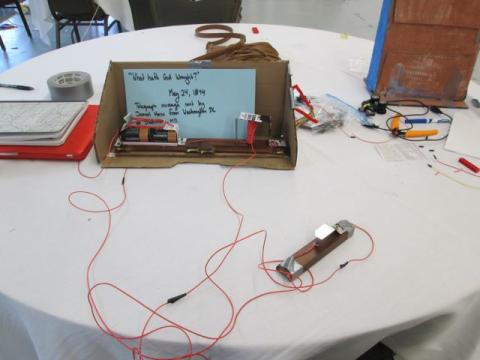
Most projects, however, are not that simple. So back to the telegraph.  I spent some time at CMK this summer learning to build one. And it worked, sort of, if you were not too picky about being able to distinguish between dots and dashes. (Dots were good, but when you held it down a bit longer it tended to get stuck, so the dash never ended.)  I am planning on having students, in pairs, build telegraphs that will allow them to send their dots and dashes at least from one end of the classroom to the other, and maybe farther. When I did it, the biggest challenge was finding the right parts. Some of that was being at a hotel in Manchester. While CMK has an amazing amount of stuff, there was nothing wood that would make a strong base, so I found myself at CVS buying a picture frame, and then back at CMK cutting it up with a Dremmel tool. I have no problem saving my students from that part of the task by pre-cutting the bases on the laser cutter. That is a good use of my time and a very bad use of their time.

But then things get tricky. If all they do is put together what I have assembled following my instructions, then that inhibits their learning. If I hand them a base and tell them to go searching the internet for instructions on how to make a telegraph and then have them searching all over school for the right kinds of metals (need to be magnetic) nails, (iron) wire (right gauge, covered, etc), then how much of that learning is about the technology and how much is about bothering the maintenance staff and running around getting frustrated?

After spending a bit of time worrying about this, I decided that I would start someplace in the middle, and try it this year, and then ask the students what they learned, what they liked, and what might make the lesson better. I will provide the supplies, but not sort them out into kids, and links to several sets of instructions, a brief framework for discussion of the historical circumstances of the invention as it happened in the 19th century. Students will take it from there.

I’ll report back after I do the lesson in February.

The Role of Co-Teachers in a Maker Classroom

Making can be a highly differentiated learning process for students. At times, the adult in the room may feel pulled in 10-20 different directions, if instruction needs to be one-on-one. Rather than viewing the individual learning needs and passions of my students as too daunting of a task to undertake in my curriculum, or an obstacle to a “successful” learning environment, I began to see maker projects for their potential for serious and effective co-teaching.

zoom_photo354502_4782283

7th grade mentor spends his study halls as a teaching assistant in the iLab troubleshooting with 5th graders on programming bugs, 3-D printing and laser cutting projects

Shift learning from a teacher centered focus, to a more student centered experience, and a more progressive and democratic form of learning emerges. Technology is now able to support this in part due to access and 1:1 programs.  For instance, the resources to progress in any given project can be found free on the internet or in the collective intelligence of your whole class. As such, the definition of expert or teacher is necessarily redefined in a Maker program or project.

img_1941

an Ad-Hoc Soldering Clinic offered for students by students

In the Hillbrook iLab, knowing how to solder, program an arduino, sew, use Lego robotics or CAD (computer aided design) software for the 3-D printer and laser cutter, are highly sought after skills. Furthermore, new kid-friendly technology for constructivist learning is growing by the day, just check out Kickstarter for examples. Rather than spend days to weeks using direct teacher instruction to teach these skills to every student, we use a mentoring and certification process. Those in need of a new skill or knowledge can participate in a clinic to learn the above skills when they become relevant to a project at hand. Learning in this manner ensures that new skills are applied in context and with meaning, hopefully solidifying the knowledge for students. Rather than wait for the teacher to get professional development in every new technology before students get a chance to experience it, we leverage student experts that are passionate and ready to share their knowledge. A great example of this came this summer.

Last summer, the Hillbrook iLab, hosted students of the Breakthrough summer program. This pilot collaboration sought to achieve two goals with two populations, the young Breakthrough teachers (typically seniors in highschool or college students themselves) and the students in grades 7 and 8.  First we sought to outreach to young educators on the tools of digital fabrication and the pedagogy of a maker classroom.  As a result of this training, and a six week applied experience, teachers could have a more diverse and competitive resume. Students from public schools gained access to tools of the iLab, not available to them at their public schools, through a creativity fostering elective course. This exposure could give students more comfort with and viability within the competitive nature of the college application process. At the same time, I was being trained on how to use the 3-D printer by a student who had spent the past few months getting to know it.  Current 6th grader Brian, showed me the basics and then created a user guide for TinkerCAD, the design software that we use for the 3-D printer.  When the Breakthrough students arrived, Brian also spent several hours in the iLab during his summer vacation teaching eight visiting students how to 3-D print.

img_2225

Rising 6th grader working to create a user guide for the 3-D printer

When asked to reflect on the experience, Brian wrote, “I am very happy that I was able to share my strength with teaching breakthrough students. Tinkercad is easy to me because I have patience working on long projects and I am a visual learner. I have had loads of fun working with the students on Tinkercad and the 3D printer. I think the students were able to learn a lot and I hope they use 3D printing in the future.”

More recently, I have been blessed with a 7th grade teaching assistant who has been programming in HTML for years. Two hours a week, I have a second set of eyes and questions to help kids problem solve. Seeing this young man mentoring hard skills in diagnosing coding errors, as well as gently talking 5th graders through the emotionally charged issues that arise during the design process, has been an inspiration to me. Furthermore, all my co-teachers have not been students; I am learning to reach out to our grand parent population, as well. Watching a retired electrical engineer struggle through an electrical circuit with ten and eleven years olds is a powerful scene reminding us that learning is a human trait and not a consequence of schooling or age.

In a Maker classroom, the adult no longer fills the role of sage on the stage, but rather acts more like a librarian, coach, maker in residence or mentor, pointing students in the direction of knowledge. Sometimes that direction is a book, a youtube how-to or Brainpop video, and sometimes it is peer. In the world of making, children are celebrated for their expertise and ability to share that with others. The most famous example of a child expert comes from YouTube superstar, come author, Super Awesome Sylvia. In a world increasingly marked by self-publishing and democratic access to online education, age and gender begin to become less relevant, debunking old stereotypes about who is an authority in any given topic.

After teaching lab-based science for ten years in subjects ranging from robotics to puberty, and now needing to know the severity of missing a } in a line of code, I am proud to still be a learner myself. These are exciting times to be a learner to be sure, and I for one am glad that I can share these experiences with my co-teachers of all ages.

Avoiding Cookie Cutters

by Keith Ostfeld

Last week, I helped fill in on the floor in one of our making spaces – the Inventors Workshop. When I arrived, the staff member I was santa-pultsrelieving was helping a girl to build a small, tabletop catapult (our theme for the week was the Turkey-pult in honor of Thanksgiving). But, I noticed something – almost everyone in the workshop was creating a very similar catapult design. While not intending to do so, our staff member had accidentally set up a “cookie cutter” situation – she knew a design that worked and encouraged all of our visitors to make the same design so they always had nearly instant success. However, one of the great things about making and tinkering is the struggle – learning from mistakes and making improvements in order to create a better product. Failure is always an option, so long as we use what we learn to improve our creations. So, I encouraged her (and the visitors) to more focus on how catapults work, looking at the science, and the sorts of materials we had available to them that could help them make their catapults. I’d pose questions as they designed and built, asking them about functionality, what could they change to improve it, etc. I facilitated their construction, acting as an advisor (and safety supervisor) instead of a director.

A few years ago (I’ve lost quite a bit of weight since then, but yes, that’s me), I did a video around this same topic, only it was Santa-pults – check it out here and have fun making catapults!

Making for Making Sake? or STEAM for 21st Century Job Skills?

Making for Making Sake? or STEAM for 21st Century Job Skills?

screen-shot-2014-11-24-at-6-54-02-pm

   – Kropotkin

Thank You Sylvia Martinez of Invent to Learn for this Conversation

According to Educational Philosopher Gert Biesta, professor of educational theory and policy at the University of Luxembourg, “Education debate tends to be based on a truth about the nature and destiny of the human being, a truth about what the child is and what the child must become.” Is anyone else daunted by this task? Some of us feel we are at a precipice in education that is fueled by a growing interest in MakerEd, and with this shift has come a lot of questions. Lets start with a recent question offered by Sylvia Martinez to our MakerEd community through her blog on November 20th. In this, Sylvia asks, “Should schools embrace Making because it develops job skills?” Paulo also addressed this in his keynote speech at FabLearn in a slide title “jobs versus powerful ideas.” “Making for making sake!” should be our mantra!

Or should it…and who gets to be part of that conversation, because like it or not, it will determine who gets hired to “teach” making at your schools and it will drive other funding issues as well. Can we dream about such an educational climate without first addressing how our current economic or political models support the adapting philosophies of MakerEd? I turn to my colleagues for answers, especially that of new STEAM Director (aka Maker in Residence) at the St. Gabriel’s School in Austin Texas, Patrick Benfield to help me map the landscape for our schools. For further inspiration, I have been learning how to speak Tiny Dutch words to stay informed by the Netherlands.

Arjan van der Miej, Per-Iver Kloen and Jelmer Evers, are a few of the educational pioneers in the Netherlands (some of whom presented at this year’s FabLearn) artfully connecting ideas in educational philosophy, with the whimsical optimism of making to answer some of the above questions. Arjan will tell you, he is not a revolutionary, but an evolutionary. He finds hope in redefining education for the future because he is engaging his students in the discourse. Together they are figuring out what MakerEd is, and how MakerEd fits into our society’s value systems. If this is a process of evolution, says Arjan, (inspired by Paulo’s description at his keynote speech at FabLearn), we are working together in a global network (thanks to social media, FabLearn and dedicated nonprofits) to code the DNA of MakerEd. When asked, “Now What?” regarding the future landscape of MakerEd, Jelmer Evers, replies in Twitter brevity, “Uniqueness, to come into the world.” It seems as though the possible future of MakerEd is presented to us like a potential period of punctuated evolution then, not unlike the Cambrian event, just add some LEDs to the menagerie.

Now Back to Sylvia…

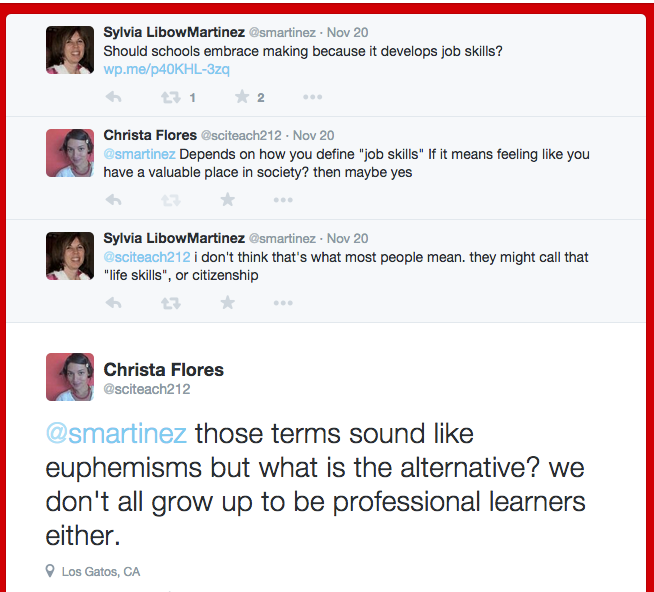
I first responded to Sylvia’s blog question via Twitter (see feed below). Now I feel that her question deserves a formal conversation, as I had an itch regarding the use of the concept or term “job skills.”

screen-shot-2014-11-24-at-5-42-21-pm

Informed by the historical emphasis on STEM due to global competition in the 1950’s to the present, I wanted to return to Sylvia’s point that the STEM crisis is misdefined. Using Sylvia’s reference, I dug into the IEEE (Institute for Electronics and Electronic Engineers) Spectrum Forecasters survey a bit more. The survey was taken of members and outside engineers and it asked questions such as those related to “the shortage of STEM students in the pipeline.” I found this quote interesting:

To the point that we should teach the STEM fields because they have enjoyed a reputation for being secure or well-paying jobs to pursue, well, that gets even more complicated. The career centered prestige of STEM fields resonates as strongly with upper middle class families sending their kids to private schools, as it does for low income families who can’t hedge their bets with their child’s education. For these populations, marketable or “job skills” is not a dirty word. In their culture, it is noble and not to be discussed as if just economically driven and not intrinsically rewarding enough. Call it a sign of a system you disagree with, and then move on, or change it.

So, if the STEM pipeline does not have a true shortage, and job skills for uncertain markets are not what should motivate us, then is this really a conversation about a shortage of inclusivity in STEM? If having a STEM career means you have a purposeful life and feel empowered to make the world a better place, then should our focus be to make the population of employable problem solvers even more diverse? If so, lets describe this needed “unfair advantage” so we can all understand what that means?

In the end, all this discourse and tweeting and questioning is a privilege. I do not get paid a living wage to be a Fellow, I get paid to teach science. In STEAM focused or Maker classrooms we do take the white coats off (sometimes) and get dirty making more technology mastering, math and science loving, empowered outsiders. I am grateful for my work and for those of you still reading. Happy Thanksgiving (Met Dankbaarheid) M.Ed. folks. Lets start Coding Together!


Works Cited

  1. Biesta, Gert (Nov. 2014) “Freeing Teaching from Learning: Opening Up Existential Possibilities in Educational Relationships” Studies in Philosophy and Education. http://link.springer.com/article/10.1007%2Fs11217-014-9454-z#
  2. Blickstein, Paulo (Oct 24, 2014) “I Have Guts Too” FabLearn 2014 Opening Keynote. Stanford University.
  3. Bouza, Tereasa (November 26, 2014) “Initiatives seek to tap into children’s creativity” Fox News Latino Link: http://latino.foxnews.com/latino/news/2014/11/26/initiatives-seek-to-tap…
  4. Charette, Robert N. (August 2013) “The STEM Crisis Is a Myth Forget the dire predictions of a looming shortfall of scientists, technologists, engineers, and mathematicians” http://spectrum.ieee.org/at-work/education/the-stem-crisis-is-a-myth
  5. Erickson, F., Kneller, George F. (Nov 2002) “Comment: Culture, Rigor, and Science in Educational Research” EDUCATIONAL RESEARCHER vol. 31 no. 8 21-24 http://edr.sagepub.com/content/31/8/21.short
  6. Fountain, Henry (OCTOBER 31, 2014) “Putting Art in STEM” New York Times http://mobile.nytimes.com/2014/11/02/education/edlife/putting-art-in-stem.html?_r=2&referrer=
  7. Fukuyama, Francis (Sep. – Oct., 1998) “Women and the Evolution of World Politics” Foreign Affairs Vol. 77, No. 5, Published by: Council on Foreign Relations
  8. Kumaga, Jean (September 2013) “Is There a Shortage of STEM Students and STEM professionals?”  http://spectrum.ieee.org/tech-talk/at-work/education/is-there-a-shortage-of-stem-students-and-stem-professionals
  9. Kropotkin, Petr Alekseevich, and Paul Avrich. The Conquest of Bread. New York: New York UP, 1972. Print.http://www.leedugatkin.com/files/3514/0603/7672/The_Conquest_of_Bread.pdf
  10. Spectrum Forecasters STEM Survey Report: Third Quarter 2013 by Advanced Technology for Humanity http://spectrum.ieee.org/ns/pdfs/forecaster/SpectrumForecastersSTEMSurveyReport.pdf
  11. Selvage, Jennifer (Novenber 2014) “Pushing Women and People of Color Out of Science Before We Go In” Huffington Post Blog http://www.huffingtonpost.com/jennifer-selvidge/pushing-women-and-people-_b_5840392.html

18th Century Buildings, Vector Drawing, History, and Math

Sometimes a technology skill building activity takes on a life of its own, and this time a simple inkscape tracing project turned into a colonialbuildings1collaboration with math and a spring board for several related activities.

Last year students reported on surveys that one of the most challenging parts of their end of they year project in my 8th grade US history class was using the free vector drawing program, Inkscape, to translate what they designed into cuts on the laser cutter.  We had practiced once before the big project, but they said if they had done it a bit more they would have felt more comfortable when it came to designing their own work. (The end of the year project is to design a monument to a 20th century American woman, I have written about it here. http://bournidealab.blogspot.com/2013/05/design-monument-8th-grade-history.html)

So I designed a project where each pair of students had to trace an image of a building from Colonial Williamsburg to create a 2d model. I worked with the math teacher to decide on a scale, so all the buildings could be compared when we were done. We gave the students one of the real dimensions from the building, and they had to work out the scale for their final wooden building.

Our lab director, Angi Chau, wrote an instructable for downloading and installing Inkscape on a mac, and she also included a helpful template set up for our laser cutter. http://www.instructables.com/id/Installing-and-Setting-Up-Inkscape-for-laser-cutti/

It took longer than I had hoped, (4 class periods rather than 2-3) but the students did an amazing job. They replicated not just the exterior shape of the buildings, but the details of 18th century architecture as well. I had first thought we would cut the buildings out of cardboard, but as I saw what they were drawing I decided it was worth it to take the extra time to cut out of wood.

We took the buildings back to the classroom, and they were the backdrop for several discussions about architecture, the technology for glass making at the time (many small windows!) and some interesting questions about the difference between public buildings, such as the Courthouse, and private buildings, such as the William Randolph House.

The math teacher loved the project, and so she created the next extension. We take the 8th grade class to visit Colonial Williamsburg as part of their Washington DC trip, and so she designed several measurement activities to go with the scale and drawing project. While we were in Williamsburg, they had to take a photo of themselves standing in front of the building, and work out some of the measurements from that photo. Many of the students remarked at the small size of many of the buildings. Even an important public building like the Courthouse was, to them, rather small.

The students reflected that while the details of using Inkscape were challenging, they like the way the project turned out, and they feel more confident with the tools.

The next step will be doing the project again, this time each student working alone, and using early 20th century buildings for comparison. I will be doing that with the 8th grade in February or March this year.

New: Making and Tinkering: A Review of the Literature

A new literature review was just released by the Board of Science Education (an NSF funded program associated with the National Academies) called:

Making and Tinkering: A Review of the Literature, by Shirin Vossoughi and Bronwyn Bevan

http://www.sesp.northwestern.edu/docs/publications/1389898569543ea0951a19d.pdf

The Board of Sciences has commisioned this and several other papers focused on informal and afterschool STEM learning. More information and links to the other papers are on their website. http://sites.nationalacademies.org/DBASSE/BOSE/CurrentProjects/DBASSE_086842

The paper is a goldmine of research supporting tinkering and making activities that support learning – not just in STEM and not just in informal settings. Paulo’s research, Papert, and Leah Buechley’s FabLearn 2013 speech are all referenced (and my book too!)

The list of the other commisioned papers is interesting as well. All the papers are linked from this site.


Commissioned Papers

Formative Assessment for STEM Learning Ecosystems: Biographical approaches as a resource for research and practice by Brigid Barron

Citizen Science and Youth Education by Rick Bonney, Tina B. Phillips, Jody Enck, Jennifer Shirk, and Nancy Trautmann

Evidence & Impact: Museum-Managed STEM Programs in Out-of-School Settings, by Bernadette Chi, Rena Dorph & Leah Reisman

Children Doing Science: Essential Idiosyncrasy and the Challenges of Assessment by David Hammer and Jennifer Radoff

Broadening Access to STEM Learning through Out-of-School Learning Environments by Laura Huerta Migus

Making and Tinkering: A Review of the Literature, by Shirin Vossoughi and Bronwyn Bevan

The church says “Amen”! : Leah Buechley rocks as she works to decenter “Making”

Leah Buechley rocks and I have been impressed and moved by her since we met.   When she was working and researching at the MIT Media Lab High Low Technology Group, Leah also had a tremendous impact on Learn 2 Teach, Teach 2 Learn.

She and her graduate students had a deep understanding for the need for making to extend to under-represented groups and set aside slots in their Media Lab education research workshops for our Boston youth of color.  Because of Leah, many of our youth got to experience soft circuits, computational design and paper electronics first hand and at Learn 2 Teach, Teach 2 Learn we were early and enthusiastic adopters of these technologies.

Leah also was generous in giving us samples of conductive threads, conductive fabric scraps and other materials so that we could experiment and make them available.  This summer, we were able to offer Open Style Lab teams access to some of the scraps and pieces and electronics that we still have from Leah to help them design accessories for people living with disabilities. You can find a great little video of Open Style Lab’s work with footage of them working at the South End Technology Center @ Tent City here:

Open Style Lab 2014 – A Short Documentary from Open Style Lab on Vimeo.

Leah is now preaching (and the church says “Amen” indeed!) how to rethink who “makes” and what they “make” to take the story of making off its present center around fairly well-off White and Asian guys to include and celebrate women, people living with low incomes and under-represented groups.

At the 2014 Fab Learn conference, I heard of the impact of Leah’s ending keynote to attenders, but was unable to find the video footage.  Today I had the pleasure of watching what I believe must be an extension of her Fab Learn n a Keynote Address to the Eyeo 2014 Conference.  In this video, Leah speaks about the deep connection between making and being human, breaks down what “maker” and “making” has come to mean and suggests ways to complicate how we think about making in terms of its breadth and who is considered to be a maker.  You won’t be sorry you took 30 minutes out to watch it!

Eyeo 2014 – Leah Buechley from Eyeo Festival // INST-INT on Vimeo.

The “Unstructured Classroom” and other misconceptions about Constructivist Learning

img_7493

Is Student-Centered Code for Lord of the Flies?


Ask any average kid what his or her favorite part of the school day is and you will probably get the answer lunch or recess. Kids love unstructured time because they have the privacy to fail while taking risks or learning how to be a social primate. At recess, kids have nearly 100% choice over what to do with their bodies, with the safe assumption that in case an injury does occur, an adult on duty will be on the scene in due time. Provide kids with a rich, not necessarily antiseptic space to explore and they teach us a lot about ingenuity, inclusivity and learning through play. Whether passionate about the physics of soccer or the game theory involved in the antics the day of a middle school dance, learning is experiential and self-directed at recess. Regardless of what passion takes over their choice time, we as adults trust them to make safe choices for the most part and we respect their individuality. So why does that trust shift when those same children come into our classrooms?


In the three years that I have been teaching science through the lens of making or inventing and problem solving, I have often heard the iLab, referred to as “unstructured,” by some well meaning adults. This harkens back to the discord between what we know progressive education can be versus what we envision when we think of a “progressive classroom.” When I worked at Calhoun in New York City, we were considered a progressive school and we often had the debate about what we mean by the term “unstructured.” The debate would invariably follow a conversation with a nervous parent that would go something like this, “Its good for some kids maybe, but my son doesn’t do well in an “unstructured” classroom.”

img_2279

Student-Centered means having access to the tools and knowledge needed to set and reach learning goals. In this simple example, having tools out for a help-your-self community workshop feeling does the trick.


If that child struggles in his or her academic classes they may have an Individualized Learning Plan, which often involves the suggestion to write every instruction down for the child and to be explicit regarding the modes for success in your class.  In other words, the best thing for the student to be and feel successful is to tell the child what and how to learn, as much as possible. While at first glance, this kind of teacher-led structure, which we want to spare high achieving kids from normally, seems like good teaching. We even have the perfect safe sounding term for it, its called scaffolding. My concern is that some scaffolding is tantamount to helmet laws which may be teaching us to be less safe in the end. Having had the gift of watching students learning in a student-centered classroom, however this translates to me, as nothing more than a lack of trust for children’s innate desire to learn what matters to them and an equal instinct to find importance through autonomy and risk taking and helping others. Thankfully, I am not alone in my uncensored trust of children as progressive playgrounds in Europe and Berkeley Ca, are beginning to prove.


By its own existence, a pre-set school curriculum assumes that children can not be held responsible for their own learning. On the one hand we as adults who work with kids, know kids do not always know what they do not know. Learning how to learn means seeing the stepping stones between just an idea and an idea that works. The skills of research and the use of tools for learning in general, are sometimes better taught step by step in the same fashion for most. On the less optimistic hand, cookie cutter curriculum also allows for some ridiculous falsehoods that many adults live in fear of. For instance, most adults worry children would not learn to read, or write, or to do math, left to their own devices and need the structure of school to make those skills materialize. Thank god dire circumstances still allow for disruptive questions to be asked, such as those asked by Dr. Sugata Mitra, allowing for a more diverse picture of who we are as a species, one that engages in learning for the sake of learning.


Here is my response to the claim that a maker classroom is unstructured. There are skills to be gained in any maker style curriculum on a spectrum from totally student driven to totally teacher directed. In my classroom I lean more towards student-directed with a game-like structure. For any given unit, either patterns, structures or systems, I give a simple prompt which allows for the most diverse range of solutions for students to discover. In game like fashion, there are rules about deadlines, teams and rules about when and how long play takes place (thats built into the school day schedule). There are “levels” of achievement and complexity of learning embedded into the system to be mindful of safety, and to allow for a mentoring system so knowledge is democratic and passion-based. Allowing students to chose the complexity with which they want to solve a problem is a side of autonomy that we cross our fingers over, but in the end, even when kids pick hard problems, they are experiencing something of value in that path full of potentially frustrating dead-ends. A list of such values we have all seen in our own ways teaching this kind of learning style. This past weekend at FabLearn, Sylvia Martinez, of Invent To Learn and Constructing Modern Knowledge, put it succinctly when she compared the kind of work kids can do in a fabrication lab environment to little league baseball. The authenticity of the work that kids do in an environment of constructing, allows kids see themselves as real inventors and engineers in the fashion that a little league player can imagine being a professional baseball player. It feels real and its age appropriate.


Making is “Just” Arts and Crafts with a Technology Twist,

It is not Rigorous Enough


Using pedagogical practices that fall under the title of making are subject to the discourse around how to ensure and measure rigor. The usual answer to the problem of rigor (which is code for college readiness) is to have standardized tests. Tests are reassuring data points that allow administration and parents and admissions officers to feel like we are basing policy on logical and scientific measures. Here is where progressive education loses the fight. No matter how student-centered or innovative your curriculum, if you give a letter grade to students at the end of that course you focus attention, and attention is what we value, on product over process. This imbalance in priorities is beginning to not only confuse constructivist educators, but parents as well. Three events this week have got me reflecting on assessment again and how it plays a vital and controversial role in making in educational settings.


The first event that got me pondering assessment tools, was a conversation between two of my students, who spoke on the student panel at FabLearn Saturday afternoon, and audience member and colleague Jaymes Dec. When Jaymes Dec asked my students at the end of their talk how they were graded, there was a pregnant pause. It was at that moment I considered the fact that my students did not have a clear idea of how they were “tested” on their project. Then one of my students said with some reservation, “We were graded on how we got along..” The second student added with a bit more assurance, “We were also graded on a pass or fail. If we got the machine to work we passed, it we didn’t we failed.” In reality, I graded them on a point system likened to the pass/fail concept, but with room for random point loss to make the system look normal. They earned points for their work away from school (homework points) and they got points for meeting benchmarks (reflections on peer critique sessions), as well as turning in video or written essays (self-assessments) defending a grade of pass or fail. In the end I am assessing how well they can make a claim, support it with evidence and tell the most accurate and compelling story of a their education. I am training them to think like scientists and to speak like storytellers. Part of me feels a sense of relief that they don’t know what part of their year gets the final grade, that way they see all the parts as potentially important, not just the behaviors that can affect their letter grade.


The second conversation I had was with two very intelligent people about the style of assessment I have been testing and using for the past two years in a making centered classroom at Hillbrook. It also happened that the conversation was centered around a narrative report I had written regarding their son. In short I found myself defending how I am able to whittle down all of the learning that happens in a unit which consists of single projects that can last two to four months out of a nine month school year. That is a lot of schools hours to defend to a parent paying a premium for those hours, unfortunately I do not have the test scores to rest my laurels on. The assessment my students experience on a daily basis is formative in nature, on-going and extends outside of the boundaries of a classroom. It can not wait for the end of a unit, it must be happening at every moment. Formative assessment that does not get a letter grade also allows students to feel assessed more on their collaboration skills, resilience and ability to gain the knowledge necessary to improve the performance of their inventions, the stuff they think is also important to be learning at their age.


The third event that sparked my imagination this week was listening to all of the dedicated and intelligent offerings at this year’s FabLearn conference, which felt as though it had an emphasis on inclusivity and equity. I learned that making is artistic and it is about craftsmanship, so it is definitely arts and crafts, but that is just semantics. Making is also about gaining mathematical literacy through doing and testing. It is about asking questions and collecting information like a real scientist. Making is also transforming kids’ experiences of school by teaching them how to think, giving them a sense of purpose and competence that can lead to a life long love of learning and problem solving. Finally, FabLearn opening keynote speaker Paula Hooper, senior science educator and learning research scientist at the Exploratorium reminds us how constructivism fosters a sense of equity and inclusion for kids. Hooper tells us a story of identity through agency and technology literacy. “You bring who you are culturally and the experiences of your past. Knowledge, that is not just connected to the mathematical concepts at hand,” Hooper inspires us to dwell on. Making is an outlet for kids to be confident in math, science and technology when they might have felt shut out in a more traditional science and math classroom. Add in the literacy skills needed to tell that rich of a learning journey and you are talking about one of the more engaging, not to mention authentically rigorous, curriculums a school can provide for its students.


But alas…what about the tests? Perhaps Paulo Blikstein said it most wisely, at the close of the short paper share at FabLearn on Sunday. “It takes time to find good metrics to assess (making in education), we still keep doing it in the mean time, and document,” encourages Blikstein. So here I am, continuing to document my thoughts on the state of maker education post FabLearn 2014. Thank you to all of those who made it such a game changing event in our pursuit of educational reform.